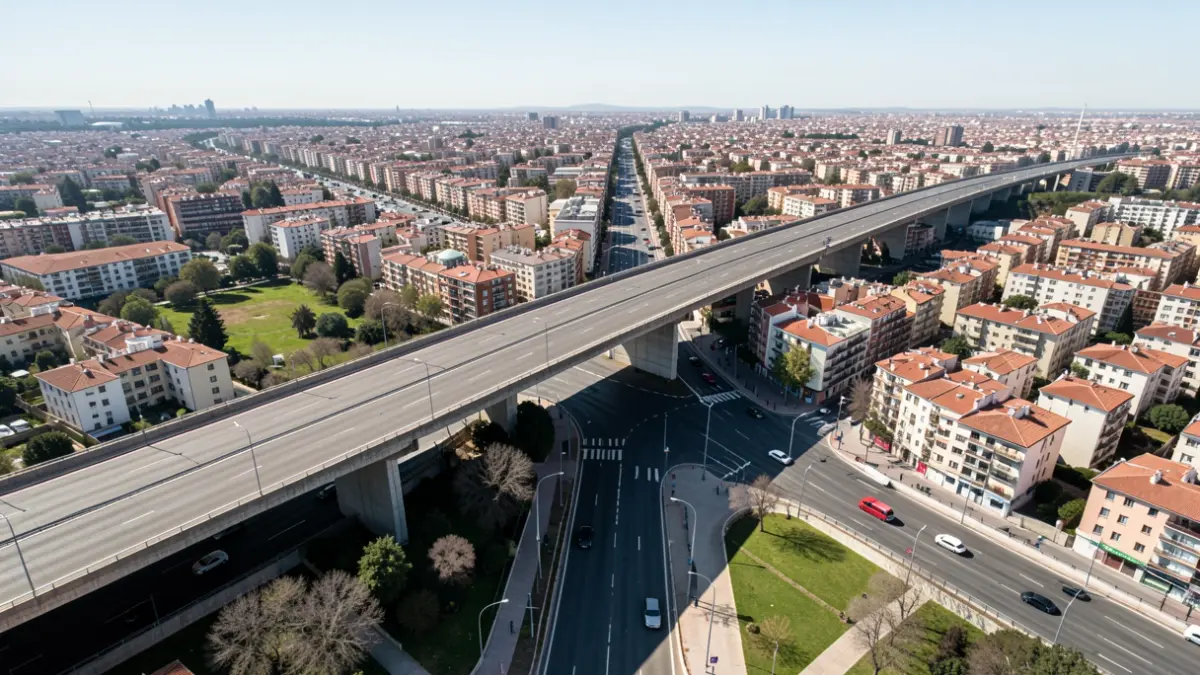
The controversial 'Scalextric' in Puente de Vallecas, an infrastructure dividing the Vallecas and Retiro districts in Madrid, will continue to stand for now. Its potential demolition is contingent on the progress of the Abroñigal operation, an urban project that could offer a solution to this physical barrier.
Meanwhile, the Madrid City Council has unveiled the ‘Vallecas Abierto’ plan. This initiative includes pedestrianizing nearby streets, installing a vertical garden, creating new pedestrian routes, and building a municipal facility under the bridge. However, residents' response has been critical, labeling the proposal as "a band-aid" and a "patch" for a long-standing demand: the dismantling of the elevated overpass.
The removal of the 'Scalextric' has been a persistent neighborhood demand. In 2021, the Cibeles Plenary unanimously approved a proposal by Más Madrid to initiate preliminary studies for its demolition. A year later, the Municipal Boards of Puente de Vallecas and Retiro also unanimously urged the municipal government to proceed with its dismantling.
Despite these resolutions, the City Council has argued that demolishing the infrastructure is not economically feasible and would significantly impact traffic flow. Mayor José Luis Martínez-Almeida has stated that approximately 300,000 vehicles use the bridge daily, and its removal could cause gridlock in the affected districts.
The ‘Vallecas Abierto’ plan features a 700-meter vertical garden to reduce noise, a municipal facility at the northern end of the bridge, over 3,600 square meters dedicated to pedestrians, five pedestrian itineraries, and the pedestrianization of streets like Monte Olivetti. The works, with a budget of 11.5 million euros, are expected to be completed in 2028.
Almeida has defended the project as "real and possible" for revitalizing a degraded area. Regarding potential undergrounding, he has not ruled it out but links it to the development of the Abroñigal operation, which could create new urban opportunities for the city's south.
The municipal opposition and neighborhood associations have strongly criticized the proposal. Más Madrid believes it does not heal the urban "wound," while the PSOE dismisses it as a "cosmetic action." Neighborhood entities call it a "mockery" and "absurd waste," demanding firm steps towards definitive dismantling.
The Regional Federation of Neighborhood Associations of Madrid has also questioned the project, arguing that it allocates 11.5 million euros to an operation with little real improvement for residents who daily endure the noise, pollution, and urban barrier posed by the overpass.
For now, the Vallecas 'Scalextric' will remain part of Madrid's urban landscape, as residents and the opposition keep the demand for its demolition alive.