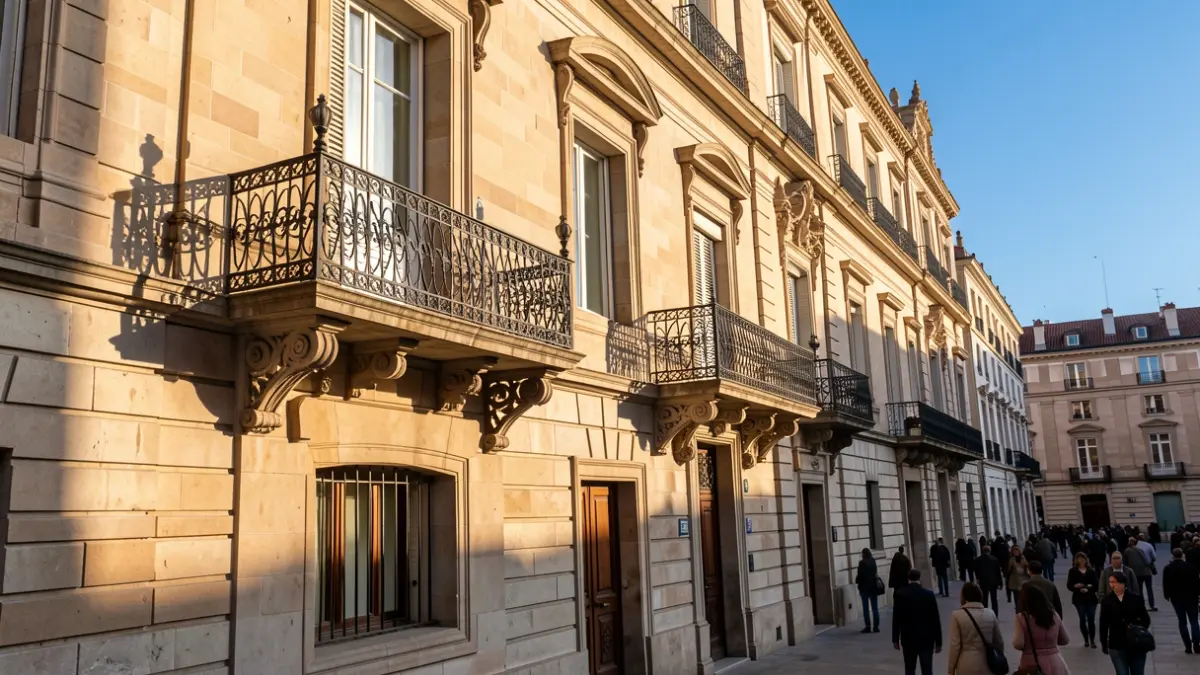
Political tension in the Madrid City Council was evident in the latest Plenary session, where the municipal government faced harsh criticism from opposition groups, PSOE and Más Madrid. The main debate revolved around the council's decision to compel Casa Árabe to vacate the Escuelas Aguirre before the building's rehabilitation works begin.
Socialist councilor Pedro Barrero accused the administration of Martínez-Almeida of acting hastily and urged for a solution that would allow the building's renovation to coexist with the institution's continuity, which he described as "strategic" for Madrid's international projection. Meanwhile, Más Madrid councilor Carolina Elías framed the decision within a "sectarian" cultural policy, suggesting it was more a political than a technical move, thus jeopardizing one of the capital's key spaces for cultural dialogue.
The municipal government's response came from the councilor-president of the Salamanca district, Cayetana Hernández de la Riva, who denied any ideological motivation. She asserted that the action was driven by "responsibility and management" and cited reports from the Court of Auditors highlighting a "critical financial situation" and "irregularities in public procurement" at Casa Árabe.
However, the debate on the consequences for Madrid's international standing and the institution's future continued. Pedro Barrero questioned the City Council's failure to clarify the building's future use after Casa Árabe's departure, raising doubts about a potentially pre-determined "destination." Culture delegate Marta Rivera de la Cruz rejected the notion that Casa Árabe's move would diminish the capital's international influence, defending Madrid's cultural offerings.
The session's first major confrontation involved José Luis Martínez-Almeida and Rita Maestre. The spokesperson for Más Madrid criticized Madrid for becoming a "theme park" for "great fortunes," while workers "have to live in another city." Martínez-Almeida responded by labeling Maestre an "extractive elite" and a "leader of absenteeism" at the City Council.
Later, the municipal spokesperson for the PSOE, Reyes Maroto, faced her first major head-to-head with the mayor as the confirmed candidate for the 2027 municipal elections. Maroto denounced the rise in inequalities and housing policies, accusing the mayor of "dismantling the network of equality spaces" and "harboring violence" by supporting the mayor of Móstoles, who is under investigation for alleged sexual and labor harassment. The mayor retorted ironically that "Madrid does not need eco-feminist resilience" and criticized the PSOE regarding the "only yes means yes" law.
The debate concluded without clear progress on Casa Árabe's future, with the eviction deadline set for September 1st, while the City Council has yet to specify its temporary location or the building's future use. The opposition views this uncertainty as a sign of the process's improvisational management.