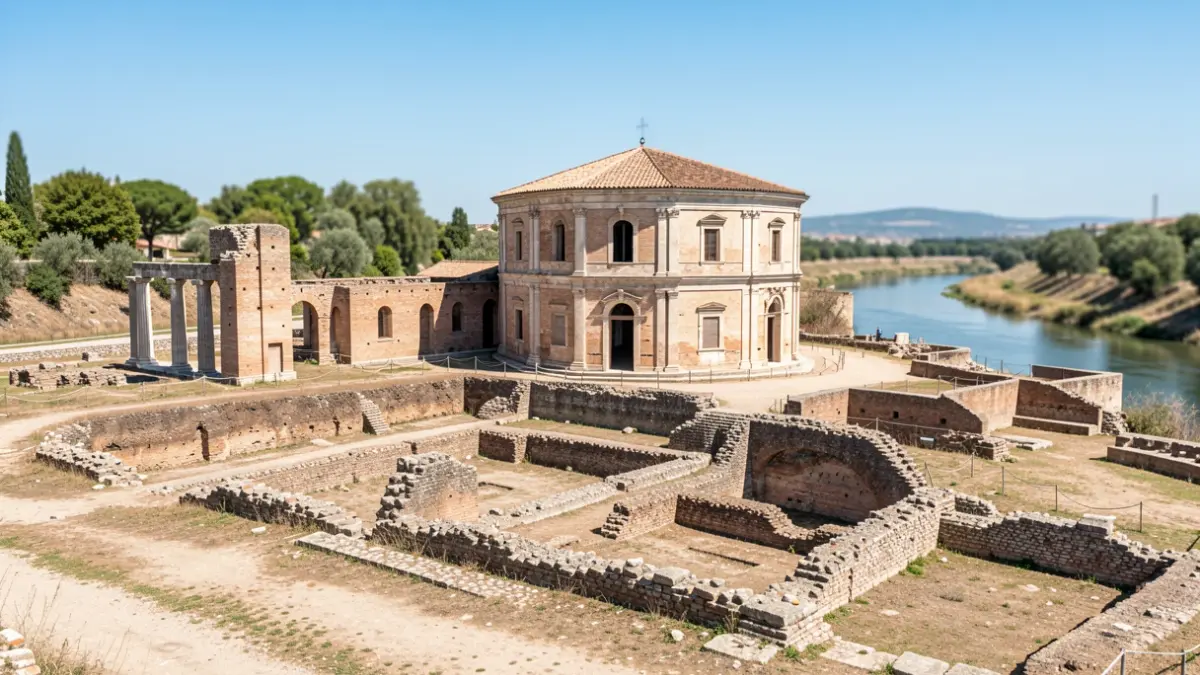
A unique enclave in the region for its octagonal floor plan and over 1,600 years of history is now officially an Asset of Cultural Interest, the highest protection status for Madrid's heritage. On the banks of the Jarama River, within the municipality of Valdetorres de Jarama, lie the remains of one of the most singular Roman villas on the entire Iberian Peninsula. On June 1st, the Governing Council of the Community of Madrid approved the declaration of this archaeological site as an Asset of Cultural Interest (BIC) in the category of Archaeological Zone, the highest distinction granted by Spanish law to historical heritage assets.
With this declaration, the Roman villa of Valdetorres de Jarama joins the select group of Madrid sites that have the most robust protection against any threat of deterioration, alteration, or disappearance. The site was already part of the region's Plan for Accessible Archaeological Sites, making it a space open to the general public, but this new status definitively reinforces its long-term preservation.
What makes this villa truly special is not just its age—dated between the late 4th century and early 5th century AD—but the way it was conceived and constructed. Its main building features an octagonal floor plan, an architectural rarity that immediately distinguishes it from any other known Roman construction in the region. While the vast majority of Roman villas in Hispania distributed their various rooms in separate, independent sections, the villa at Valdetorres integrated all living quarters into a single, compact structure. Bedrooms, service areas, reception spaces, and work areas coexisted under one roof, organized around a central courtyard or peristyle surrounded by a ring of rooms. These rooms communicated through small corridors located at the corners of the octagon, creating a continuous and well-articulated interior circulation. This architectural solution, unusual for its time and geographical context, makes the villa of Valdetorres an exceptional case study within Hispano-Roman archaeology.
The site was discovered in 1977, with the first excavations beginning the following year. Since then, archaeological work continued for several decades, uncovering heritage of immense historical and artistic value. The most recent chapter of this recovery story unfolded between 2018 and 2022, when a comprehensive intervention was carried out, including the complete excavation of the villa, cleaning and consolidation of structures, and partial reconstruction of some walls to aid visitor understanding of the space. Additionally, panels and exhibition elements were installed, along with recreations of wall paintings, pavements, statues, and bases, providing a much clearer idea of life in this place over sixteen hundred years ago.
Among the discoveries revealed by excavations over the years, some stand out. One of the most striking is the finding of a glass furnace in the villa's inner courtyard, along with remains of the objects produced there: bottles, window fragments, and other pieces demonstrating that this site was not only inhabited but also a production center. Coins found at the site span a chronology from the pre-Constantinian era to the late 4th century, allowing for a precise tracing of the location's history and its various occupation phases. Metal objects, including tools and weapons, have also been recovered, as well as abundant pottery and decorative bone and ivory pieces that were part of the household furnishings. However, the most notable collection for its richness and rarity is the sculptures unearthed at the site. These figures represent animals, deities, and heroes from classical mythology, crafted from various types of marble and ranging in height from 15 to 75 centimeters. A sculptural ensemble of this caliber is exceptional within the context of Madrid's Roman villas, placing Valdetorres in a privileged position within the regional archaeological heritage.
The Roman villa of Valdetorres de Jarama is not just an object of study for specialists; it is a space open to the public, designed for anyone to approach the region's history in an accessible and understandable way. Its inclusion in the Plan for Accessible Archaeological Sites ensures it has the necessary conditions to receive visitors, with signage, guided tours, and interpretive materials that enhance the experience. With the new declaration as an Asset of Cultural Interest, this commitment to dissemination and preservation is officially reinforced. For the residents of the northern area of the Community of Madrid, this enclave represents a unique opportunity to directly experience a little-known but fascinating chapter of the territory's history.