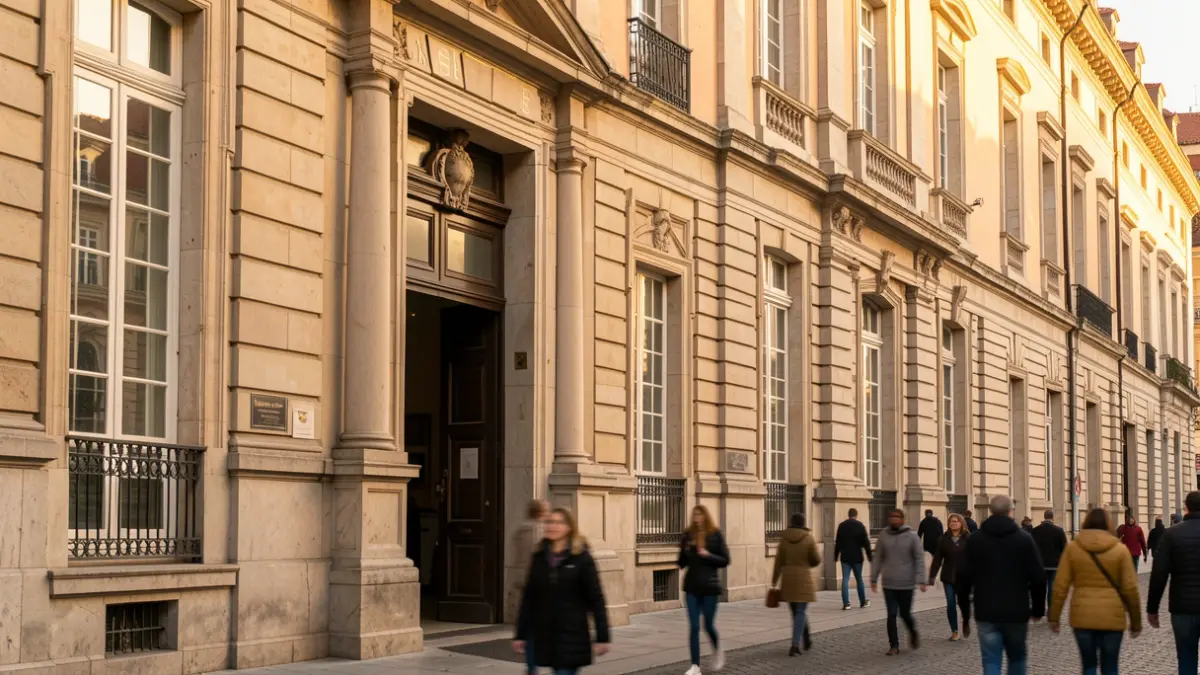

The President of the Community of Madrid, Isabel Díaz Ayuso, has announced via the social network X the National High Court's decision to suspend the declaration of the Real Casa de Correos as a democratic memory site. This building, the seat of the regional government, was used during the Franco dictatorship by the Political-Social Brigade (BPS), a police force responsible for the repression of opponents.
The original text, authored by Nino Olmeda, expresses surprise and sadness at the judicial decision. It mentions that Jesús Pedroche, a former leader of the PP of Madrid, shared his bewilderment, recalling that during his tenure as a counselor, a cell was preserved as a testament to the repression. Pedroche also welcomed the Supreme Court's rejection of Ayuso's request to halt the regularization of immigrants, advocating for 'dignity' as a guiding principle against the rise of 'deniers and the far-right'.
The article's author criticizes the National High Court's decision, arguing that the history of the Puerta del Sol, where the Real Casa de Correos is located, is intrinsically linked to Franco's political police and was a torture center. He emphasizes the importance of remembering these places to honor victims and prevent the repetition of historical errors, citing international examples such as Argentina, Chile, Uruguay, or South Africa, where torture sites have become memory spaces.
Ayuso's argument regarding the potential 'adverse effect on the institutional image' of placing a commemorative plaque is presented. The author, identifying as a former political prisoner, sent a letter in 2024 to Ayuso requesting such a plaque in memory of the dictatorship's victims. He considers the failure to recognize the rights of those detained and tortured at the Sol headquarters to reflect a 'grave lack of empathy and a denial of history'.
The text also warns of setbacks in historical memory policies in countries like Argentina with the arrival of reactionary leaders, and suggests that something similar might be occurring in institutions where the PP collaborates with Vox. It mentions cuts in funding for museums and educational programs, and the implementation of policies that question historical truth.
Finally, the author describes the National High Court's decision as a 'lifeline' for Ayuso's 'obsession/whim' to 'sugarcoat the dictatorship's repression,' calling it an 'outrage' stemming from 'ignorance or significant malice'.