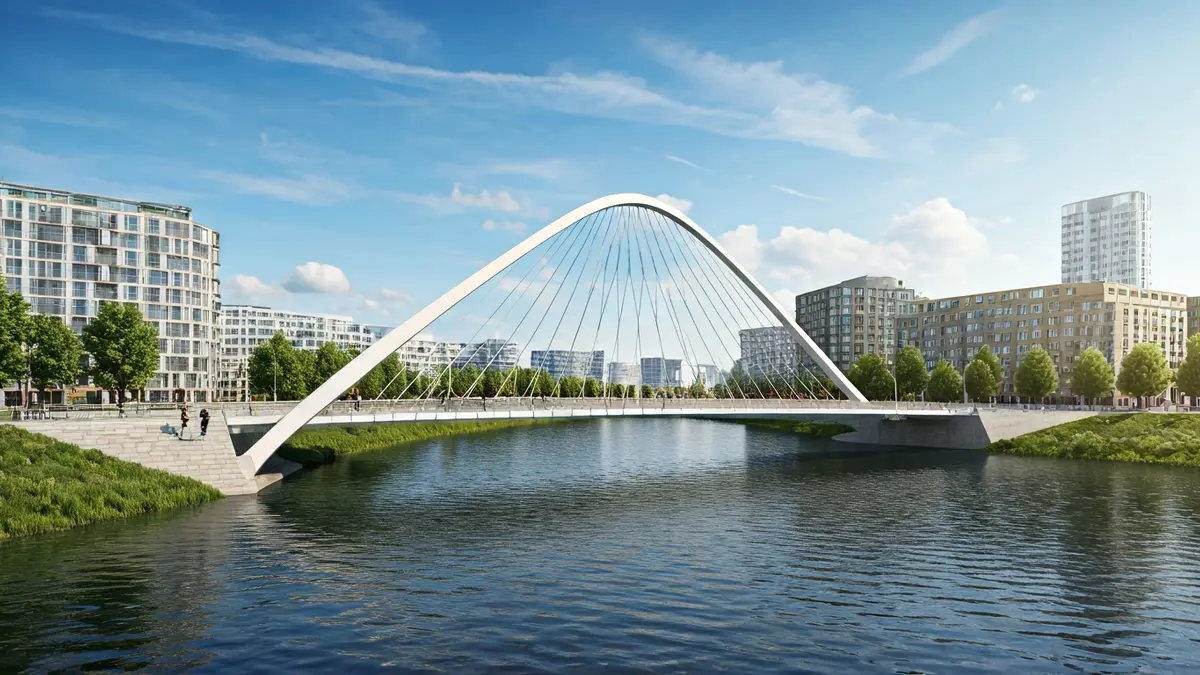
The Vado footbridge, located near the former Legazpi fruit and vegetable market, serves as a crucial link between the districts of Arganzuela and Usera, spanning the Manzanares River and the M-30. Paloma García Romero, Delegate for Public Works and Equipment, announced that the new structure will not only be more aesthetically pleasing but will also feature a dedicated space for pedestrians to enjoy river views.
The competition, organized in collaboration with the Madrid College of Civil Engineers, aims to address the current deficiencies of the footbridge. Key issues include accessibility problems for people with reduced mobility due to its steep incline, inadequate lighting, and the absence of a cycling connection. The new design will incorporate multiple access points, a significant improvement over the current single entry, facilitating use from various surrounding areas.
“"We want it to be a beautiful and functional aesthetic element as well."
Delegate García Romero, joined by the councilwomen for Arganzuela, Lola Navarro, and Usera, Sonia Cea, highlighted the technical challenge of the project, as the footbridge crosses both the Manzanares River and the M-30. The existing infrastructure was described as “very outdated, very aged, with serious accessibility problems,” underscoring the need to engage top professionals for its renewal.
The Madrid College of Civil Engineers will provide experts to evaluate proposals based on technical, aesthetic, and functional criteria. The Dean of the College, María Dolores Esteban, emphasized the importance of improving aspects such as lighting, accessibility, and overall design, aiming for “the best emblematic work for this area.”
The competition process will unfold in several phases. Proposals must be submitted by August 31. In September, a jury will evaluate the projects and select finalists. Finally, in October, the College will host an exhibition of all submitted designs. Competition guidelines and technical documentation will be published this week on the College of Civil Engineers' website and the City Council's contractor profile.
The jury, comprising experts in civil engineering, urban planning, and sustainable design, along with the councilwomen for Arganzuela and Usera, will assess structural quality, technical, economic, and constructive viability, as well as urban, landscape, and environmental values of the proposals. Three prizes will be awarded, totaling 25,000, 15,000, and 10,000 euros respectively, plus up to three honorable mentions of 5,000 euros. The first-prize winner may also be awarded the contract by the City Council to draft the preliminary and construction projects.