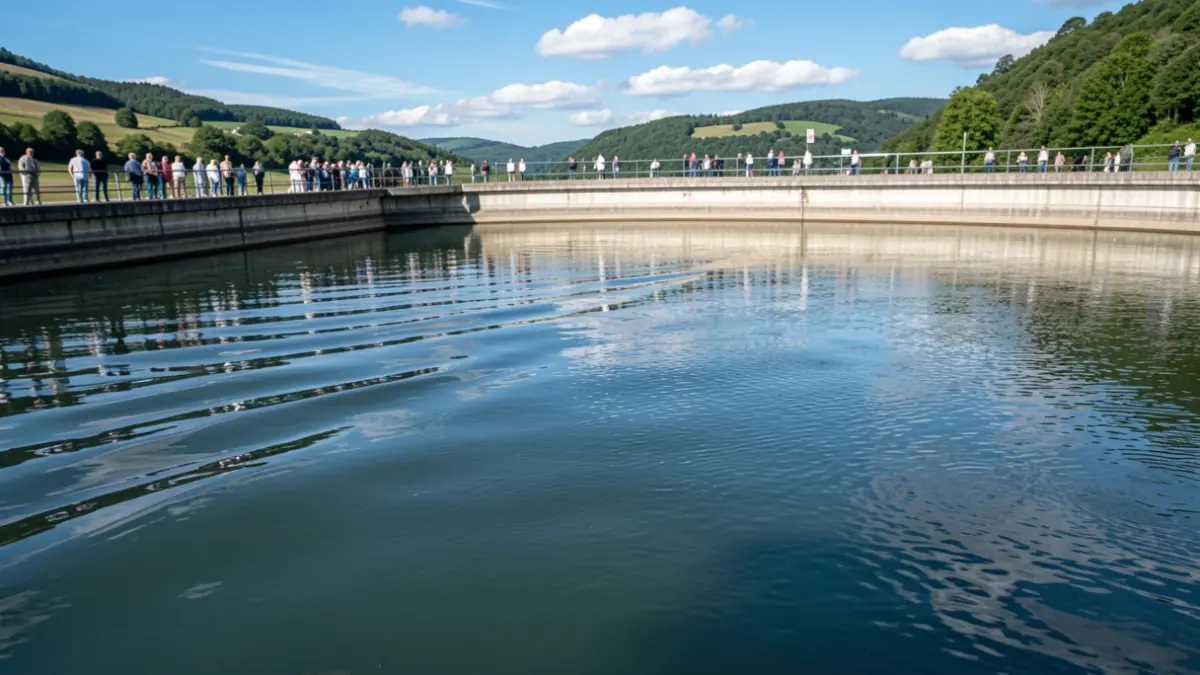
The reservoirs of the Community of Madrid, managed by Canal de Isabel II, have begun August at 72.2% of their maximum capacity. This represents a drop of nearly 6 percentage points since they started July at 78%. With 681 cubic hectometers (hm3) accumulated, reserves are close to the historical average for these dates, which is 73%.
The reservoirs with the largest capacity, such as El Atazar (at 75% with 320.8 hm3), Valmayor (at 75% with 93.5 hm3), and Santillana (at 72.4% with 66 hm3), are currently storing the largest volume of water. After remaining above average in spring, reserves have decreased in June and July, a usual pattern during the dry season, worsened by below-expected rainfall.
While Madrid capital registered 23.7 liters per square meter in July, rainfall at the dams was minimal, barely 1 l/m2. This water scarcity, added to the dryness of the soil due to high temperatures, has reduced water contributions to the reservoirs by half compared to the usual July figures, with only 6.3 hm3 compared to an average of 12.5 hm3.
July has also been the month with the highest water consumption of the year, with the Canal diverting 55.8 hm3 for supply, 10.1% more than the previous year. This figure is the highest for a July month since 2015. So far in 2026, accumulated consumption is 9.1% higher than in the same period of 2025, with 307.7 hm3 consumed compared to 281.9 hm3.
Although the hydrological situation is normal and supply is assured, Canal de Isabel II reiterates the importance of responsible water use, especially in summer. The public company promotes good practices such as avoiding watering during the hottest hours, doing it early in the morning, and conserving swimming pool water by covering them properly.
It is reminded that gestures like shortening showers, turning off the tap while soaping, using dual-flush cisterns, or running dishwashers and washing machines at full load optimize demand. The Canal also invests in water reuse, pipe renewal, and leak detection, managing to reduce per capita consumption in the Community of Madrid by more than 30% since the 2005 drought.