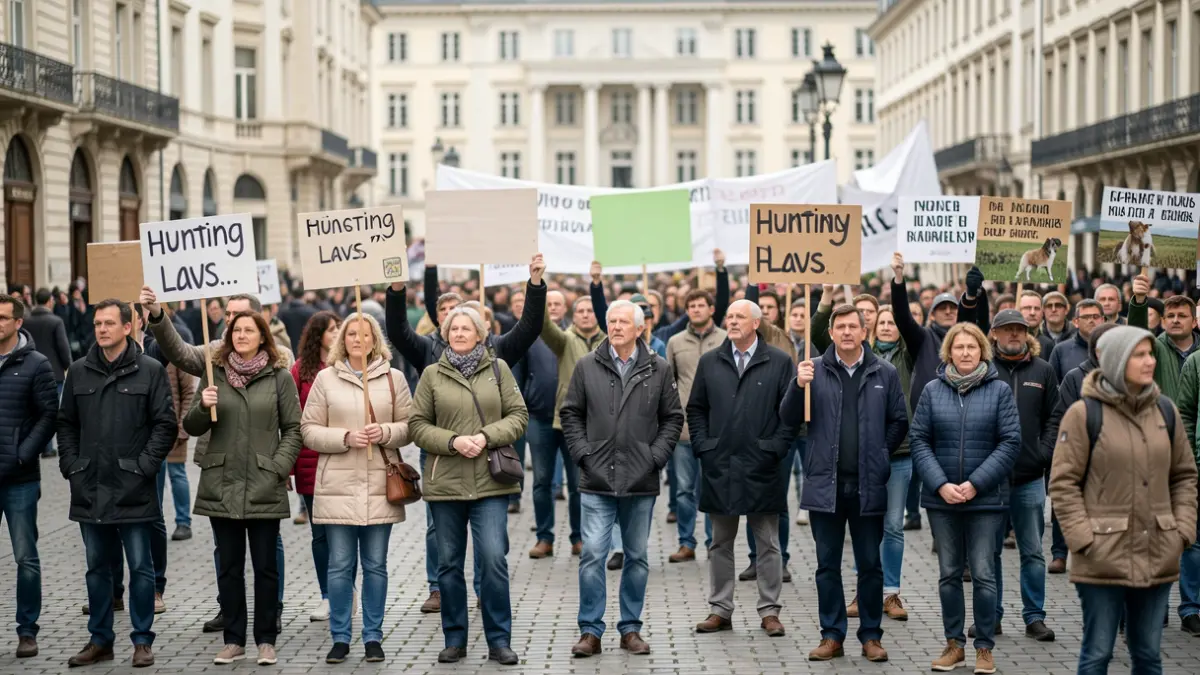
The protest, called by the platform Madrid sin Caza (Madrid without Hunting), brought together citizens to oppose legislation that, according to organizers, favors the hunting sector at the expense of the non-hunting majority, animals, and the enjoyment of the natural environment.
Madrid sin Caza, composed of the Madrid Ecologist Platform, the Empathy Association, and the No to Hunting NAC Platform, and supported by over 200 collectives, views this mobilization as the start of a broader citizen strategy to halt the most damaging aspects of the future regulation.
“"Hunting in Madrid is practiced by a minority that represents less than one percent of the population, yet occupies and uses over 70 percent of the territory."
The platform's spokesperson, Mari Ángeles Nieto, denounced that the Community of Madrid is promoting a law that expands hunters' rights against the rights of non-hunters and animals.
The organizers criticize that the legislative text, which will replace state regulations from 1970 and 1942, has been developed over three years with insufficient participation from environmental, animal rights, and nature user groups, compared to the hunting sector.
Among the most questioned points are the expansion of huntable species, the reintroduction of practices like live lure hunting, the use of new technologies to locate animals, and the possibility of restricting or penalizing non-hunters in areas where hunting activities take place. Nieto warned that the regulation would allow hunting 365 days a year and include seven species of aquatic and wading birds, some with declining populations.
The platform also rejects the use of drones, night vision, and thermal scopes, as well as the massive deployment of hunting dogs, and warns about the difficulty of access to public paths and hunting zones for hikers, cyclists, and families. Fines of up to 10,000 euros are foreseen for those who protest or hinder hunting activities.
Madrid sin Caza insists that the law, which has not yet been approved and is scheduled for a vote on June 18, can still be modified and that citizen mobilization is key. They assert that the majority of Madrid's non-hunting population should not be subordinate to the interests of a minority.
The platform has announced further activism and awareness actions to maintain pressure before the parliamentary vote, aiming to gather support against a law they deem detrimental to the natural environment, animals, and citizens' right to enjoy public spaces.