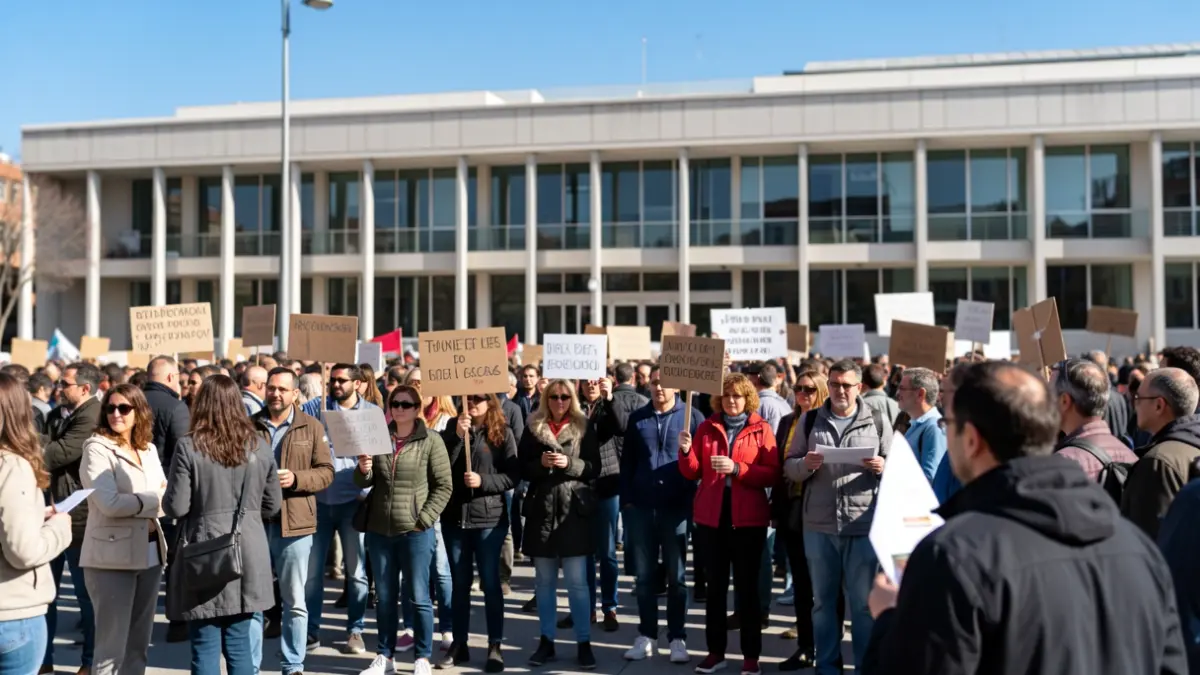
Social services in Madrid are experiencing a week of tension following accusations of removing belongings from homeless individuals and the alleged intensification of these operations coinciding with the Pope's visit. Now, the workers of Madrid en Calle, responsible for direct outreach to the homeless, have publicly voiced their concerns.
Gathered in front of the headquarters of the Area of Social Policies, Family, and Equality of the City Council, led by José Fernández, the employees, supported by the unions Co.bas and CNT, warned of a progressive deterioration in their working conditions that directly impacts the quality of care for the most vulnerable.
The controversy began after reports emerged of an instruction that, according to street team professionals, prevented prior notification to homeless individuals about cleaning protocols in their living areas. The Professional College of Social Educators of the Community of Madrid, chaired by Adolfo Rodríguez, confirmed that this practice could lead to "defenselessness" and the loss of essential belongings.
The municipal opposition, represented by Más Madrid and the PSOE, has demanded explanations from the government of José Luis Martínez-Almeida. Cuca Sánchez, a councilwoman from Más Madrid, described the measure as "cruel and inhumane" and accused the City Council of "cleaning up" the city by hiding reality instead of offering housing solutions. Socialist councilwoman Meritxell Tizón called the operations "protocols of shame" that destroy social work and trust.
The City Council, for its part, maintains that no such directive exists and that protocols are activated only for sanitation issues, always ensuring the presence of social services. However, testimonies from Samur Social workers suggest a notable increase in clean-ups in areas frequented by homeless people before the papal visit, a claim the Council has denied.
The demands of Madrid en Calle workers also target the contracting company, Grupo 5, accused of breaching agreements, and the City Council for issuing "low-bid contracts." They denounce low salaries, lack of professional recognition, and insufficient resources, such as "one computer for every two people" or a shortage of chairs.
Unions criticize the systematic rejection of flexible hours or remote work for administrative tasks, contradicting the name of the Government Area which includes "equality." They call for improvements in occupational risk prevention and specific measures for vulnerable groups, as well as continuity of social care on weekends.
Municipal sources state that the employment relationship is with Grupo 5 and that conditions are governed by collective agreements. They reject the argument of "danger" for attending to people in social exclusion, deeming it "stigmatizing." Workers, however, defend the need for a danger bonus due to risky situations.
Despite the difficulties, workers also demand more shelter places, citing "enormous waiting lists." Unions report pressure and "intimidation" from the company and the City Council regarding their demands, warning that mobilizations will continue if real negotiations do not commence to ensure service quality.