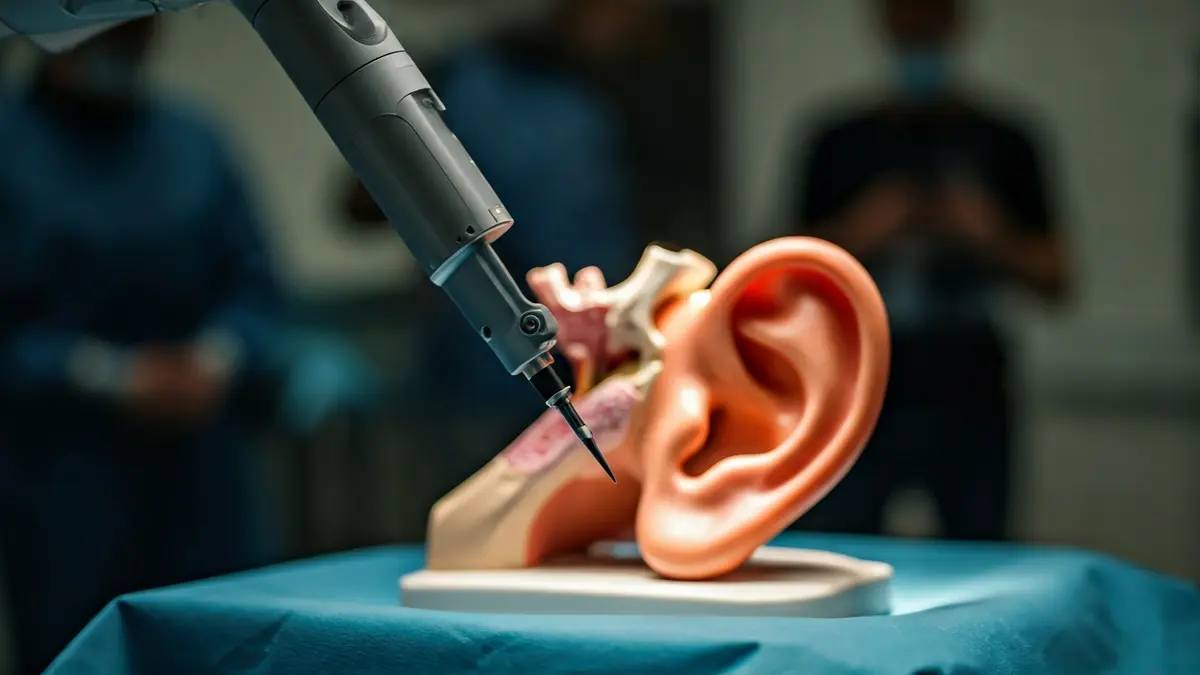
This innovative intervention involves inserting an electrode into the cochlea, an extremely delicate structure within the inner ear. The cochlea is crucial for transforming sound vibrations into nerve signals that the brain interprets as sounds.
The process demands an exceptionally slow, constant, and precise insertion to prevent any damage. The robotic arm is capable of maintaining a speed of 0.1 millimeters per second for several minutes, applying uniform pressure without oscillations, thereby overcoming the limitations of the human pulse.
This advanced precision facilitates a more controlled placement of the implant and significantly contributes to preserving cochlear structures. This aspect is particularly critical for patients who still retain some degree of residual hearing.
The use of the robotic arm allows maintaining a speed of 0.1 millimeters per second for several minutes, with uniform pressure and without oscillations, surpassing the limitations of the human pulse.
In recent years, the profile of cochlear implant candidates has evolved. Previously, it was limited to individuals with profound deafness and no residual hearing. Now, it is also performed on patients with residual hearing, which requires even more delicate and precise surgical techniques.
The Otorhinolaryngology Service at La Paz is recognized as one of the leading centers for cochlear implant surgery, performing approximately 40 interventions annually and attending to nearly 400 patients in its consultations.
Unlike conventional hearing aids, the cochlear implant is a prosthesis that enables individuals with profound deafness to regain hearing by transforming sound into electrical impulses that directly stimulate the auditory nerve.