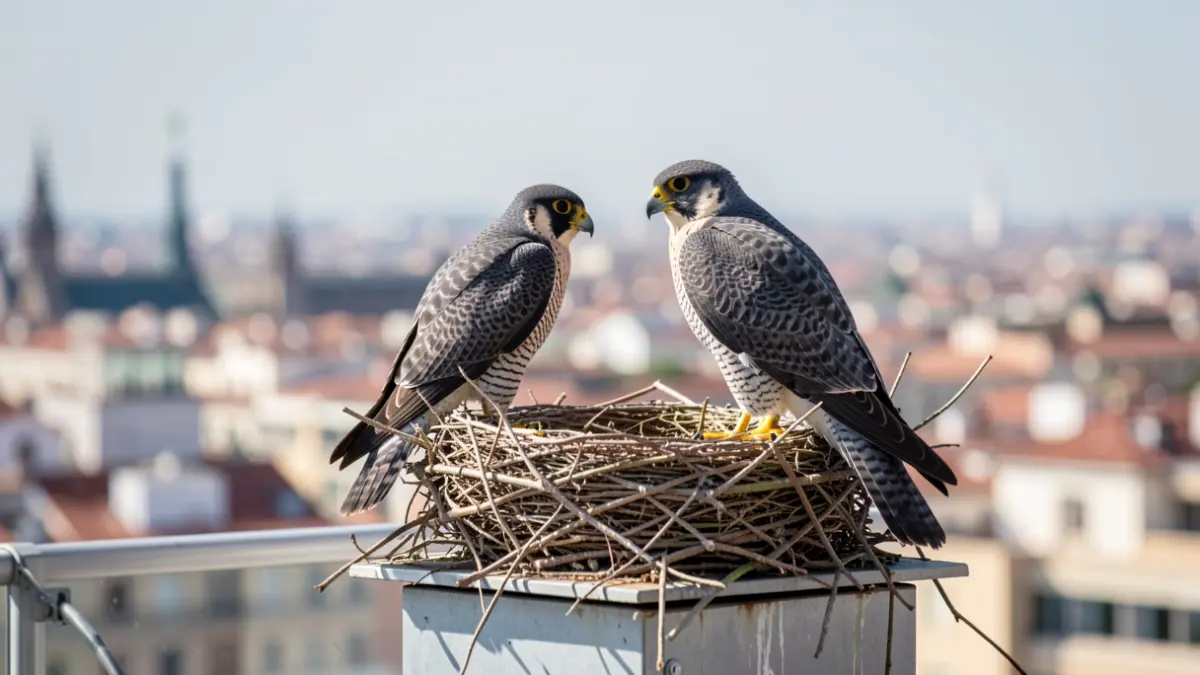
A pair of peregrine falcons has once again nested on the rooftop of the 12 de Octubre Hospital in Madrid, successfully raising three chicks in the nest box installed on the Blue Building. This marks the third documented nesting at the hospital, which has previously seen six chicks grow in earlier seasons.
These birds of prey, protected at both regional and national levels, have demonstrated a remarkable ability to adapt to urban environments. Specialized biologists are monitoring the family, with veterinary supervision provided by Brinzal, an organization dedicated to wildlife recovery. The chicks, one female and two males, show size differences and are already taking their first steps and wing flaps.
The hospital's General Affairs department has actively collaborated in installing the nest, providing access to technical areas, and continuously monitoring the situation. The hospital also assists in locating and recovering any birds that fall from the structure. The breeding cycle follows a predictable calendar, with mating in February, egg-laying in March, and hatching in April, followed by chick banding.
A camera installed in the nest box allows for live monitoring, providing detailed information without interfering with the pair's natural behavior. The current breeding pair is the same one that settled here three years ago, showing notable fidelity to the location. Peregrine falcons feed on birds and bats, acting as natural controllers of avian fauna in the city.
The physical capabilities of this species are exceptional, capable of exceeding 350 km/h in a dive. Females are significantly larger and play a key role in defending territory and providing larger prey for the chicks. The hospital's Blue Building offers ideal conditions, artificially replicating the height and characteristics of the natural cliffs where peregrine falcons typically inhabit.