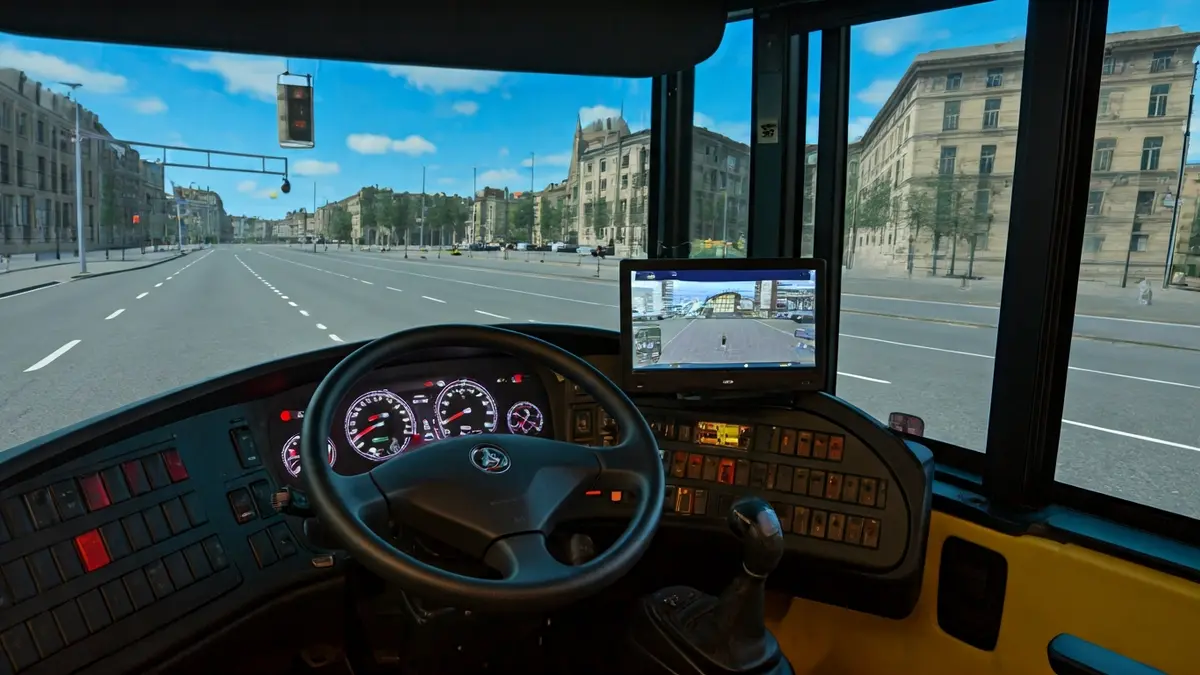
The delegate for Urban Planning, Environment and Mobility, Borja Carabante, recently visited the EMT's Fuencarral operations center, where he observed the training of new drivers. The simulators, which faithfully reproduce the driver's cabin and the conditions of a virtual city similar to Madrid, are crucial for staff training.
These systems have been updated to incorporate new functionalities, such as 6.4 kilometers of bike lanes with cyclists interacting with the virtual bus and traffic. They are adaptable to both standard (12 meters) and articulated (18 meters) bus models, and are a key tool for the EMT.
They help improve safety, efficiency, and profitability in the training process.
The four simulation cabins allow students to train in risky situations, such as adverse weather conditions, heavy traffic, the sudden appearance of pedestrians or cyclists, and emergency braking. This contributes to preventing accidents, reducing risk in critical driving scenarios, decreasing fuel and maintenance costs, and saving emissions.
In terms of training, the simulators ensure uniform instruction for all future drivers and objective evaluation. After trying one, Carabante highlighted the EMT's growth in passenger numbers, noting that 2025 closed with a record 512 million users.
“"We continue to increase passenger numbers compared to traffic. Since 2019, for example, in the case of Calle 30, traffic has been reduced by 4.5%."
Entry-level training is the final stage for candidates who pass the theoretical tests, which saw over 1,600 applicants in the June 2025 call. This intensive 175-hour training, lasting five weeks, includes theoretical sessions, simulator use, and real driving practices, both without and with passengers, before joining the 229 bus lines of the municipal network.