The delegate for Urbanism, Environment, and Mobility, Borja Carabante, accompanied by the councilwoman for Arganzuela, Lola Navarro, has presented an innovative urban biodiversity monitoring project. This initiative employs state-of-the-art acoustic sensors and artificial intelligence to accurately record the presence and evolution of birds and bats.
To validate the technology, two parks with distinct characteristics have been selected: the Valdebebas-Felipe VI Forest Park, an extensive area with high biodiversity, and Madrid Río, an urban park with intense recreational use. The presentation took place at the Madrid Río Interpretation Center, where the operational details and initial results were explained.
This initiative represents a significant advancement in applying technological tools for biodiversity monitoring in Madrid. It will provide objective, continuous, and real-time information on fauna in representative natural spaces, facilitating municipal planning for nature conservation and improving the ecological quality of urban habitats.
A total of fifteen acoustic sensors have been distributed between both parks: seven in Madrid Río and eight in Valdebebas-Felipe VI, forming a monitoring network that offers permanent information on bird and bat activity.
Carabante highlighted how innovation and technology support the protection of natural heritage, establishing Madrid as a benchmark for sustainable and resilient solutions for biodiversity conservation.
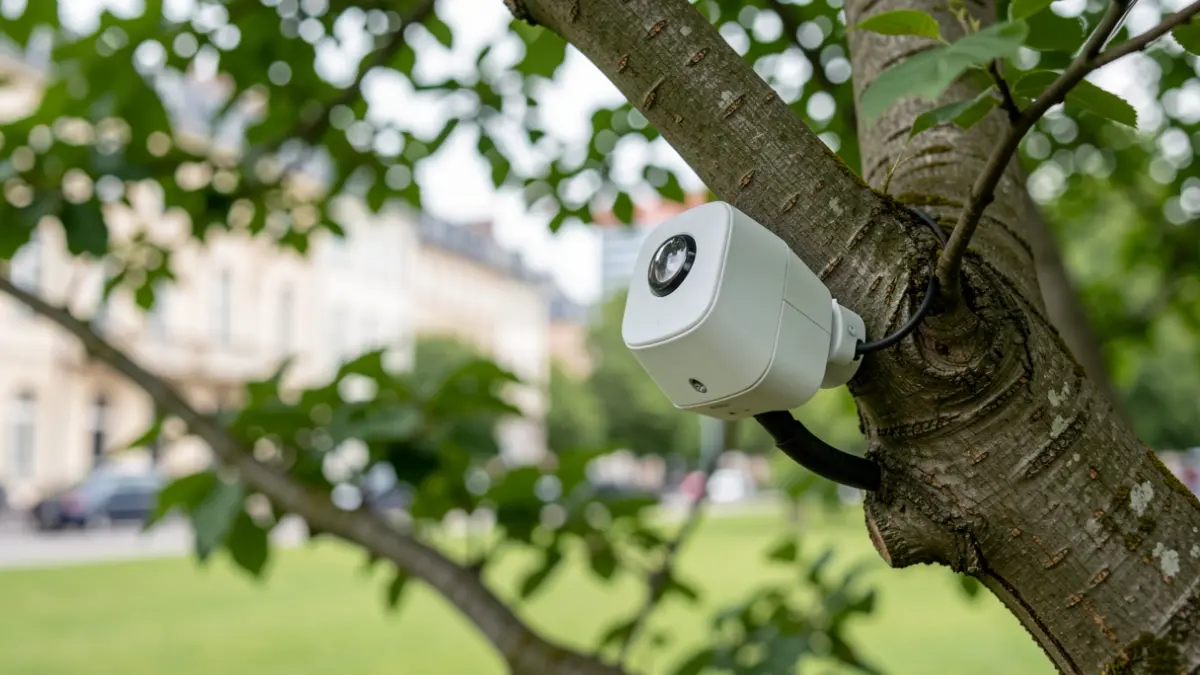
The main innovation lies in the sensors, developed and manufactured in Spain. These devices instantly process bird songs and bat ultrasounds using artificial intelligence algorithms, identifying the species without recording or storing sounds, thus ensuring privacy. They also record environmental variables such as date, time, temperature, humidity, and atmospheric pressure, allowing for the study of the relationship between species activity and environmental conditions.
The initial results are promising: in Madrid Río, 66 bird species (1,564 observations) and 13 bat species (221 observations) have been identified. The most frequently detected birds include the common magpie and the European serin, while among bats, the riparian bat and Nathusius's pipistrelle stand out.
In the Valdebebas-Felipe VI Forest Park, 103 bird species (6,885 observations) and 23 bat species (3,578 observations) were recorded. The most frequent bird species were the common magpie and the European serin, and among bats, the median noctule and Nathusius's pipistrelle were prominent.
All collected information is integrated into a technological platform featuring a digital twin that visualizes identified species and their spatial and temporal distribution in real-time. The platform includes dashboards with dynamic graphs, indicators, statistical tables, and heat maps, along with a geographic information system (GIS) for advanced queries.
Generative artificial intelligence is also employed to facilitate data analysis and the creation of personalized technical reports, streamlining municipal environmental management and supporting conservation planning.