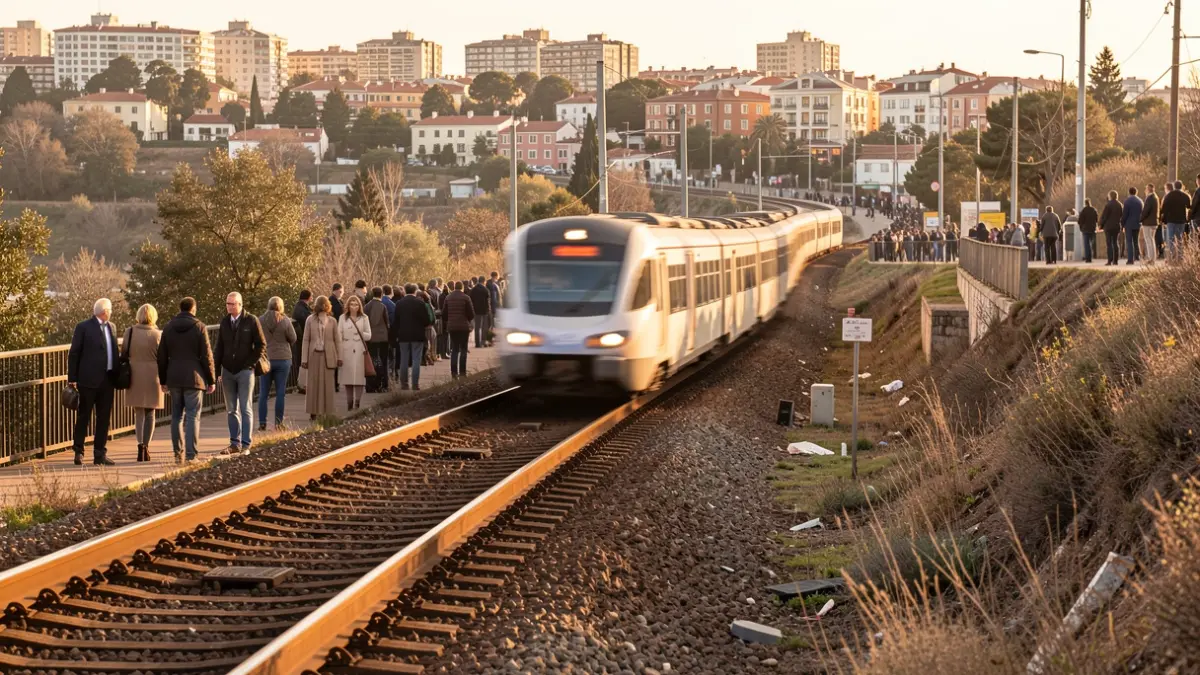
The railway line connecting Aluche and Móstoles, a key axis in Madrid's commuter network, commemorates its 50th anniversary this year. Inaugurated on October 29, 1976, this infrastructure represented a significant transformation in the mobility of the southern metropolitan area.
The original track, spanning 11.226 kilometers, offered a travel time of 15 minutes between the two locations. Its route began in Aluche, linking with the old Carabanchel Suburban Railway, and continued on the surface to Móstoles, benefiting over 200,000 residents.
From that initial layout emerged the current C-5 commuter line, which today extends over 45.1 kilometers between Humanes and Móstoles El Soto, passing through Atocha. This line is the busiest in Spain, accounting for 29% of travelers on the Madrid network.
The line, initially known as the "yellow line" and inaugurated in 1980, has undergone successive extensions, reaching its prolongation to Humanes in 2004. It currently has 23 stations and serves municipalities such as Fuenlabrada, Leganés, Alcorcón, Móstoles, and Humanes.
The integration of this route explains the absence of a C-6 line on the current commuter map, as it ceased to exist when it merged with the C-5 in 1991. Originally, the C-6 had seven stations, and its route was adapted from pre-existing railway platforms.
The line's extension to Atocha, promoted to alleviate Metro station congestion, was completed in several phases between 1985 and 1991. The definitive integration into the commuter network was consolidated with the merger of lines C-5 and C-6 in 1996, adopting the current designation.
Currently, the C-5 line transports over 72 million passengers annually. The Ministry of Transport and Sustainable Mobility has announced an investment of 1.35 billion euros for its renovation until 2031, which will include the purchase of 35 new Stadler trains, aiming to increase its capacity by 60%.