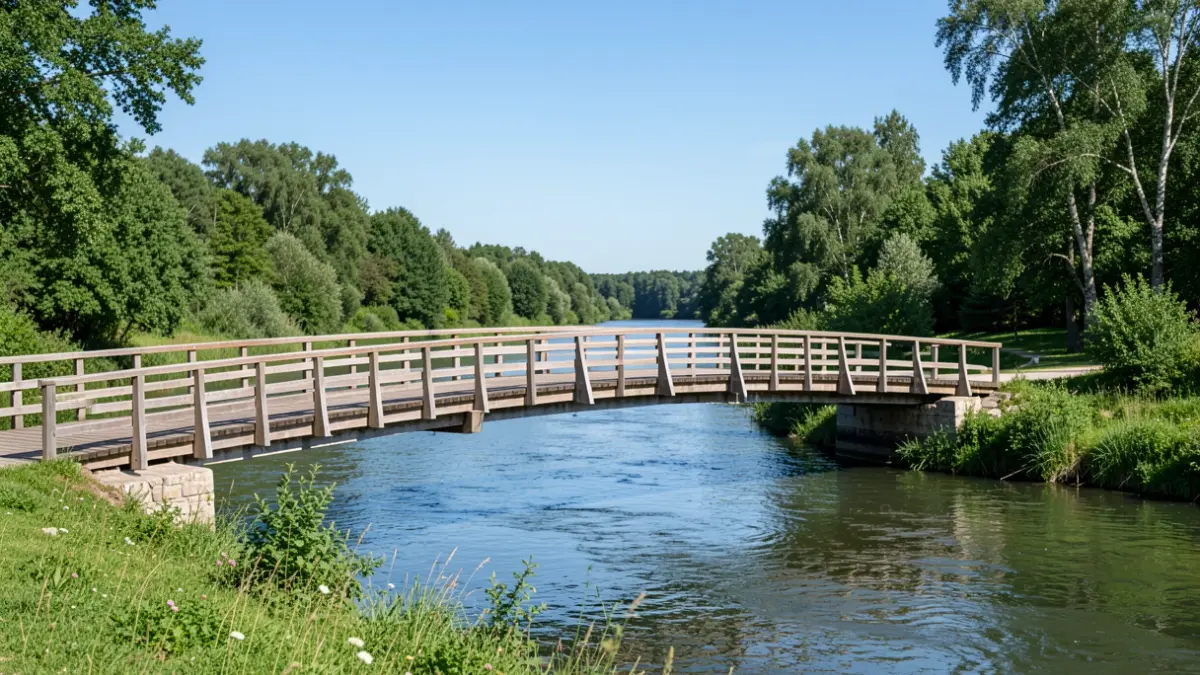
The public company Planifica Madrid has launched the tender for the project's execution design. The bridge will be located near the historic Puente del Herreño, aiming to overcome a significant barrier for pedestrians and cyclists in the riverine environment.
This action, included in the Regional Investment Program (PIR) 2022-2026, will have a global investment exceeding 2.6 million euros. The design includes a laminated wood bridge, along with the adaptation of paths, sanitation networks, and efficient lighting using LED technology.
The proposed route will have an approximate length of 950 meters. It will start from Santa Emilia street, in the border area between Alpedrete, Collado Villalba, and Guadarrama, cross the Cañada Real Segoviana, and traverse the Guadarrama River to connect with various urban roads in Galapagar.
The new infrastructure will facilitate walking and cycling between different residential areas and educational and sports facilities. Furthermore, it will offer an alternative to private vehicle use and improve connectivity for neighborhoods such as Los Negrales, Colonia España, Monte Encinar, or Los Arroyos.
A key aspect of the project is its full accessibility. Technical specifications stipulate that the route must not exceed slopes of 6 percent, thus ensuring passage for people with reduced mobility, wheelchair users, and families with strollers.
The initiative presents a notable environmental complexity, as it will be developed within an area integrated into the Natura 2000 Network, specifically within the Special Conservation Zone of the Cuenca del Río Guadarrama. The design must balance improved mobility with the protection of this valuable natural space.
The five involved municipalities have collaborated for years to advance this project, considered strategic for enhancing connectivity between towns and resolving the lack of an accessible crossing between the river's banks at this point in the Sierra de Madrid.