Collado Villalba Advances in Guadarrama River Renaturalization with New Footbridge
The installation of a pedestrian walkway over the Poveda stream marks 83% completion of the Guadarrama River restoration project.
By Alberto Delgado Sanz
••3 min read
IA
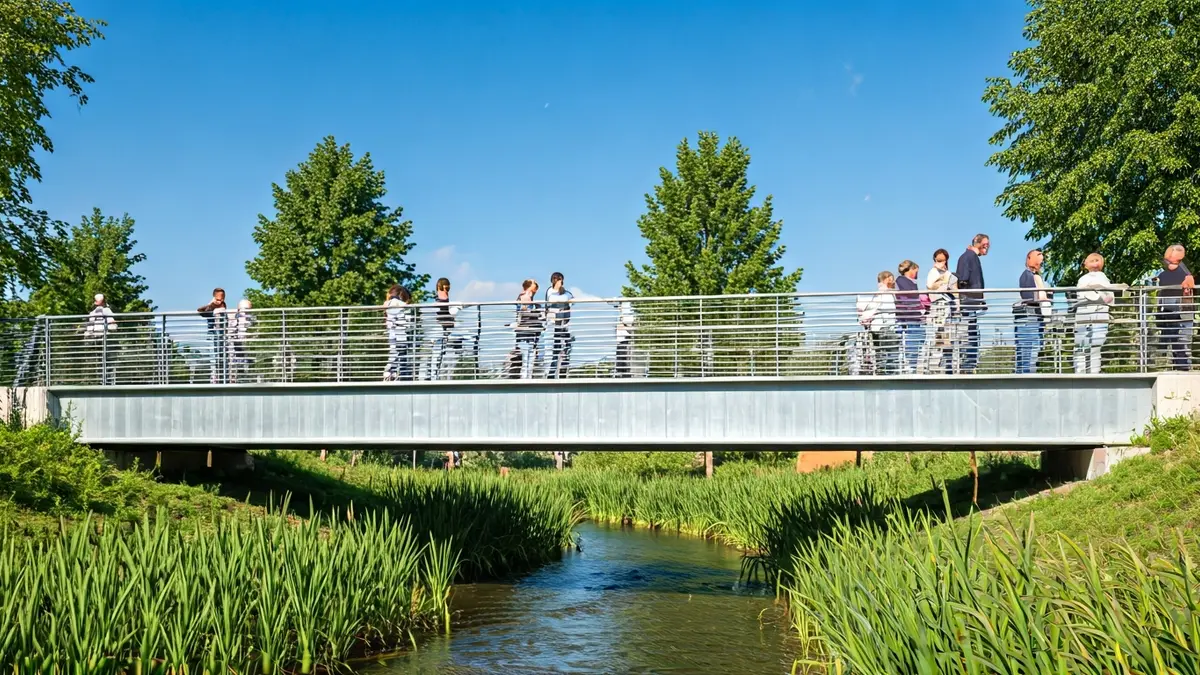
Metal pedestrian walkway over the Poveda stream in Collado Villalba.
The installation of a new pedestrian footbridge over the Poveda stream in Collado Villalba has significantly advanced the Guadarrama River renaturalization project, now 83% complete, reconnecting Parque de las Bombas with the riverside parking area.
The Guadarrama River renaturalization project in Collado Villalba is nearing its final stages. With 83% of the project completed, a new pedestrian footbridge has been installed over the Poveda stream. This metallic structure, 10 meters long with an anti-slip surface, re-establishes the connection between Parque de las Bombas and the parking area next to the river.
The old concrete infrastructure linking Parque de las Bombas to Alpedrete Street has been demolished to create a small river beach at the confluence of the Guadarrama River and the Poveda stream. This is one of the most significant actions within the riverbed restoration works, which began several months ago.
Despite delays caused by heavy rains in January and February, the works are in their final phase and are expected to be completed by early summer. Adan Martínez, the councilor for Urban Planning and Environment, explained that beyond beautifying the area with new plantings, viewpoints, and pedestrian paths, the most crucial remaining task is replacing a three-pipe conduit for rainwater collection, which was not part of the initial plan.
“
"It is important because if we do not approve this remnant and do not do this work, we would face significant fines from the Tagus Hydrographic Confederation."
To fund this improvement, a treasury surplus of over 760,000 euros will be submitted for approval in the April ordinary Plenary Session, which will prevent discharges into the Poveda stream. Mayor Mariola Vargas clarified that this work is separate from the main grant and addresses the need to repair deteriorated pipelines discovered during the project.
“
"It has nothing to do with the subsidy; it's that when creating the river park, a series of conduits were found to be in poor condition and needed repair, which we, the residents, would have had to pay for anyway. Taking advantage of everything being open for renaturalization, we are going to do this part of the work, which is very interesting."
Martínez also noted that engineers confirmed the resilience of the completed works after a recent flood, ensuring their durability. In March, the Collado Villalba City Council submitted supporting documentation to the Biodiversity Foundation, securing a grant exceeding 2.3 million euros. This means 83% of the project will be funded by European funds, with the city council contributing the remaining 489,000 euros.
The works, carried out by ACCIONA, include riverbed cleaning, access conditioning, construction of containment elements, demolition of obsolete structures, planting native vegetation, application of bioengineering techniques, service restoration, and environmental integration measures. The goal is to enhance biodiversity, improve environmental sustainability, and reduce flood risk.
“
"Those who know best whether renaturalization is done well or poorly are the animals. Despite the works, there are animals here, swimming, there are cormorants and ducks. We are seeing more and more different species, both in the Priconsa Lagoon, where we have seen them, there is even a seagull, and here. So I think it will be a very interesting biodiversity spot."
Mayor Mariola Vargas, during a visit to the site, emphasized that the project aims to unite Collado Villalba by creating spaces with paths, benches, viewpoints, and footbridges for enjoying nature. Adan Martínez concluded that this initiative restores the river environment to its natural state, as it always should have been, for the benefit of the residents.