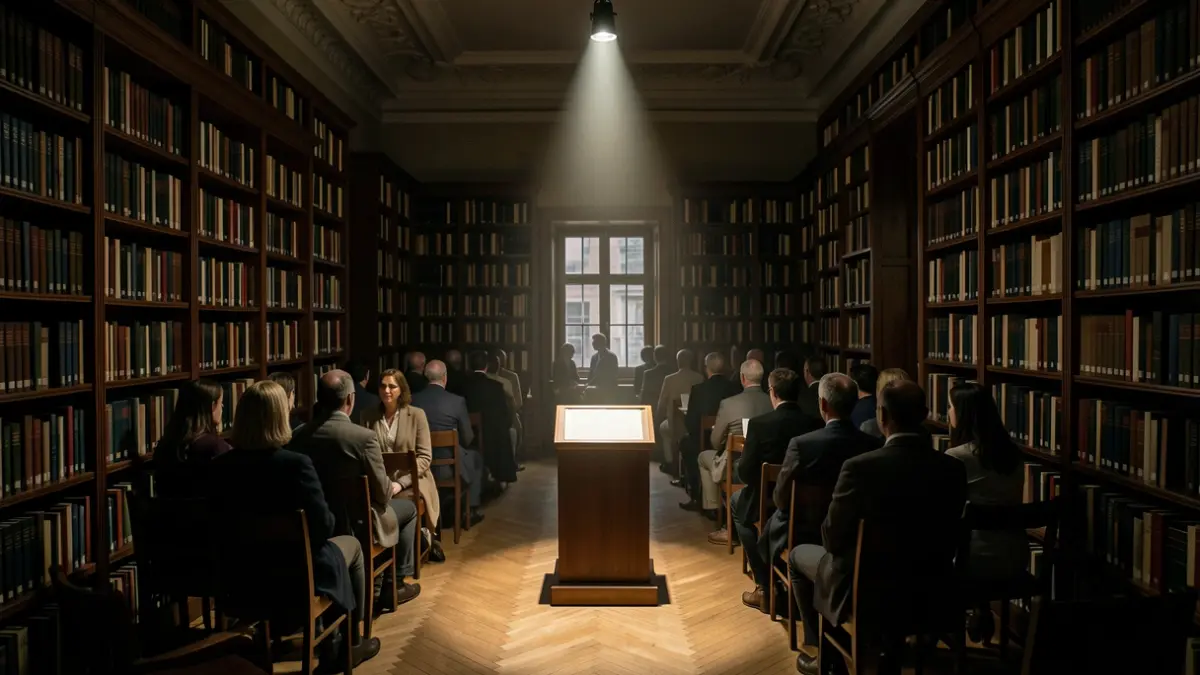
On the afternoon of Monday, April 20th, the Casa de la Cultura in Majadahonda became the stage for an event that transcended a mere conference. Under the title “Latest Developments on the Life and Death of Federico García Lorca,” Professor and Doctor of Audiovisual Communication, Federico Utrera, delivered a presentation organized by the Cultural Collective of Majadahonda. Far from closing debates, Utrera's intervention, before a numerous and participatory audience, reignited the persistent questions and fascination surrounding the figure of the Granada-born poet.
Federico Utrera began his presentation with a personal tone, sharing photographs of his family roots in Adra and Almería. This seemingly tangential start served to build a bridge between intimate memory and historical research, preparing the ground to address the difficulty of establishing a definitive truth about the poet's life and, especially, his death.
The interactive format set the pace of the event, with Utrera posing four key questions to the audience about the “Lorca mystery”: the interest between his life and work, the lesser-known aspects of both, the location of his murder, and the identity of those responsible. The show of hands responses reflected a majority leaning towards the primacy of his work, while the poet's life is perceived as the more unknown territory. The dispersion of opinions regarding the place and perpetrators of the murder indicated that, almost ninety years later, the case remains shrouded in shadows, underscoring the impossibility of closing the narrative.
The speaker reviewed various hypotheses about the murder, including the involvement of Falangist, military, and CEDA forces, family conflicts, or uncontrolled squads, without settling on a definitive conclusion. This cautious stance left a disquieting sensation: we know a lot, but not enough. References were made to the contradictions among Lorca's major biographers, such as Ian Gibson, and other equally solvent researchers like Agustín Penón or Eduardo Molina Fajardo. The need, recently pointed out by Laura García Lorca, the poet's niece, for a new biography that integrates and refines decades of studies was also recalled.
The conference added an unexpected, almost novelistic, nuance by recounting the intimate encounter between Lorca, the painter Margarita Manso, and Salvador Dalí, the latter as an observer, as documented by Dalí in his various statements and memoirs. Beyond its details, the anecdote underscores the mythical aura surrounding the poet, where life, art, and legend intertwine without clear boundaries. Particularly relevant, within the focus on "Lorca's women," was Lorca's enduring relevance as an early interpreter of female sensibility, whose characters and conflicts continue to challenge a society that is perhaps more prepared now than ever to listen to them.
The conference did not aim to resolve Lorca's enigmas, but rather to remind us that his figure remains alive precisely because he continues to generate questions. In this territory of uncertainty, the poet's presence remains inexhaustible.