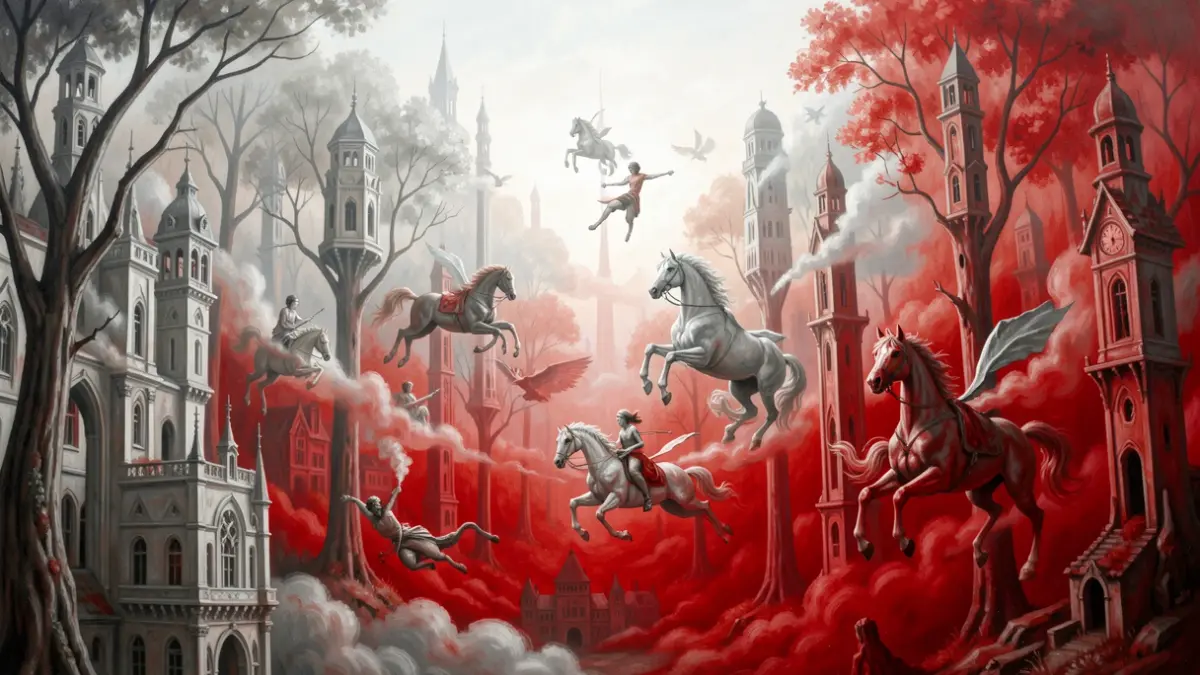
Art has always sought to transcend reason, from the visions of El Bosco and the caprices of Goya to the provocations of Dalí and Magritte. These artists explored the impossible, the absurd, and the emotional through the canvas, breaking with geometric space and gravity. Following this path, Héctor Acevedo (Lima, 1963) presents his work, which aims to invent new worlds, using desaturated tones for calm and intense reds to express inner passion.
The exhibition, titled 'The Last Refuge', is displayed in the Villanueva Pavilion of the Royal Botanical Garden. The curator, María del Socorro MoraC, describes Acevedo's art as neosurrealist, although he prefers not to be pigeonholed, starting his works with automatic strokes and later incorporating symbols and postmodern references.
María-Paz Martín, director of the Royal Botanical Garden-CSIC, notes that Acevedo invites viewers to "look beyond the visible." In his canvases, figures levitate, horses fly, and trees become shelters of memory, creating a territory where reality, dream, and imagination coexist. Martín compares Acevedo's ability to free the viewer from daily gravity to that of Marc Chagall, highlighting the artist's deeply personal voice, influenced by the memory of his homeland, Andean culture, and his unique contemporary perspective.
Acevedo explains that his work stems from the "dialogue between nature, perception, and memory." The setting in the Botanical Garden is particularly significant for him, as the space becomes part of the artwork itself, transforming the visitor's gaze. The director of the RJB-CSIC, María-Paz Martín, emphasizes that the title 'The Last Refuge' is pertinent, as trees in Acevedo's work symbolize protection and hope, reminding us that nature is not only the support of life but also an emotional and symbolic space.
Curator María del Socorro MoraC defines Acevedo's painting as "magic, alchemy, unconscious consciousness, or surrealism," but also as "symbolism and poetry." The artist hopes the exhibition will foster a "more paused and sensory experience," encouraging personal connection with the artwork and its surroundings.
The exhibition, organized by the Royal Botanical Garden with support from various institutions, will be open until January 13, 2027, in the Villanueva Pavilion. Access is free with the admission ticket to the Botanical Garden.
Héctor Acevedo (Lima, Peru, 1963) studied drawing, painting, and civil engineering before dedicating himself fully to the plastic arts. Throughout his career, he has received numerous awards, including first prize at the XV Florence Biennale (2023) and the V International Biennial of Argentina (2022).
María del Socorro MoraC describes Acevedo as "a special, sensitive, and restless being," intellectually linking him to Magritte for his visual puzzles and to El Bosco or Gerardo Chávez for the 'horror vacui' and the desperate desire to convey that something serious is happening in our society, posing questions about the future of the species.