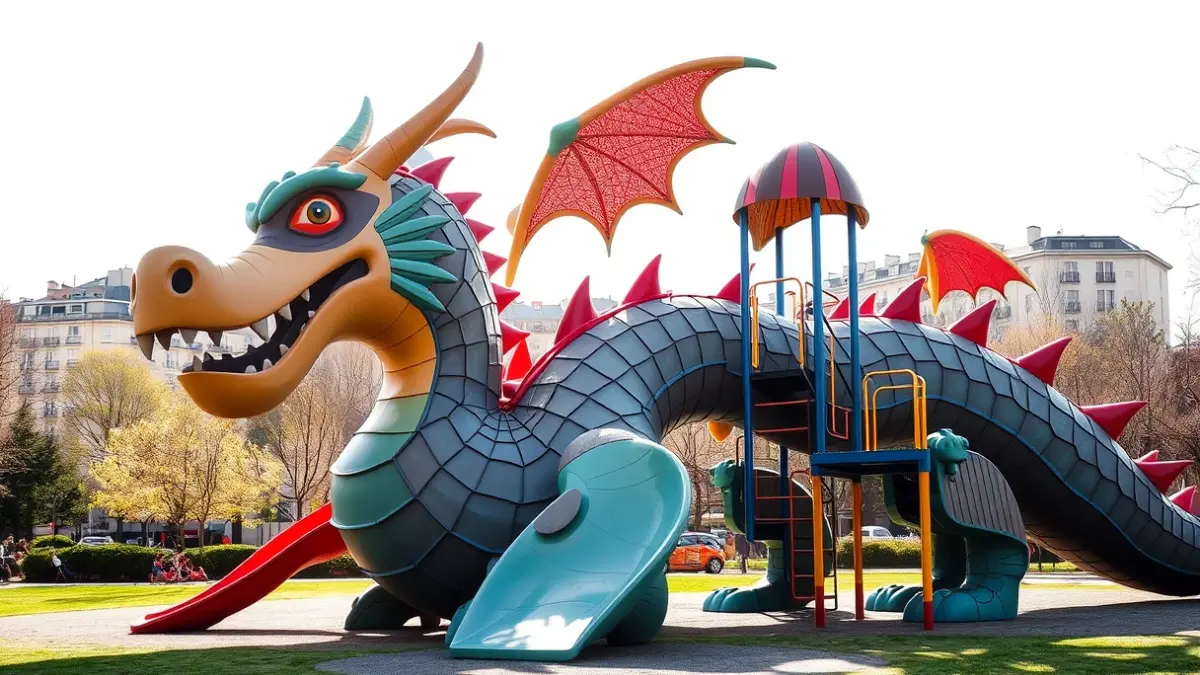
A striking dragon-shaped structure has become the new focal point of the Plaza de las Tizas, in the Usera district. This feature, which can be explored internally through nets, passageways, and a tubular slide, is part of a more ambitious project: a 1.5-kilometer pedestrian itinerary linking the heart of Usera with Madrid Río.
Since its opening in January, this route has changed the dynamics of movement in the area. The Plaza de las Tizas stands as one of the central points of the journey, which extends through renovated spaces with wider sidewalks, modern urban furniture, and a sequence of squares that set the pace of the walk. While the dragon initially captures attention, the true value lies in the cohesion and continuity achieved between the different spaces leading to Madrid Río.
The route is not linear, but allows for different ways of moving and exploring.
The playground, covering over 285 m², is designed as a continuous and accessible structure. The dragon's body, segmented into several sections, invites internal exploration via nets, walkways, and climbing elements. Inside, key components such as the net floor, rings, bars, and a tubular slide are concentrated. Outside, the area is complemented by ground-level games for various ages, including swings, sensory panels, and balance circuits, all designed with accessibility and shared use in mind.
This pedestrian itinerary, connecting the Plaza del Hidrógeno with Madrid Río, traverses 19 streets and four squares, and has involved the regeneration of 39,000 m² of public space. Improvements include wider sidewalks, the removal of architectural barriers, renewed lighting, the installation of benches and fountains, and the planting of 290 trees and over 11,000 plants. The result is a more comfortable and clear path, facilitating pedestrian movement and connecting various points of the neighborhood without interruptions.
The four main squares—Plaza del Hidrógeno, Plaza de las Tizas, Plaza de Julián Marías, and Plaza de José Luis Hoys—structure the route, offering reference points and different atmospheres. The Plaza de Julián Marías, for example, incorporates references to Chinese culture, such as a horoscope integrated into the pavement, reflecting the neighborhood's identity and the presence of the Chinese community in Usera. These elements, along with carp-patterned tiles and bilingual phrases, are distributed along the path, adding continuity and meaning to the walk.
The intervention, with an investment of 10.5 million euros, has significantly transformed the district's public space, enhancing accessibility, pedestrian continuity, and environmental quality. The itinerary provides a direct connection between the neighborhood and Madrid Río, integrating this axis into a broader network of pedestrian routes in the city.