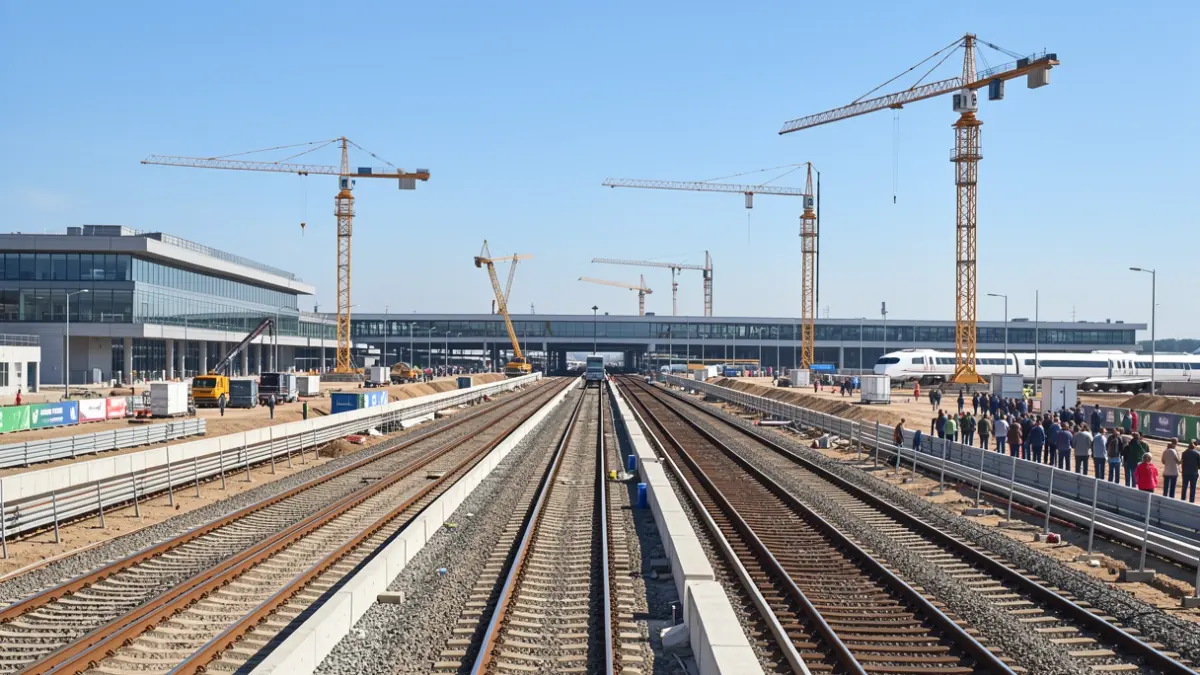
The Ministry of Transport and Sustainable Mobility has launched the final stage of works for the new high-speed rail access that will connect Chamartín-Clara Campoamor station with Terminal 4 of Adolfo Suárez Madrid-Barajas Airport. This infrastructure is considered key to enhancing intermodality and facilitating rail access to the country's main airport.
Regarding the new standard gauge track, platform works have been completed. These included the construction of walls, a new underpass on Ingeniero Emilio Herrera street, and the reinforcement of the Cercanías tunnel near the A-1 highway using metal beams over a 130-meter section.
Additionally, affected services have been restored, and the sub-ballast has been extended. Ballast laying and the installation of standard gauge track and switches have also been completed, with final tamping pending. In parallel, electrification efforts are progressing, with catenary pole installation completed in approximately 60 percent of the route, along with the placement of channels, inspection pits, and cabling for control, command, and signaling (CMS) systems.
In the vicinity of the Hortaleza technical station, complex interventions have been carried out to adapt the infrastructure for future high-speed operation. This involved shearing and reorganizing standard gauge tracks to suit the new configuration. Works included the dismantling of a switch and a track turnout, as well as the renewal of approximately 550 meters of slab track to implement a three-rail system allowing different gauge trains to run on the same section.
The work concluded with the installation of new crossings and mixed-gauge switches, the placement of gantries and electrification lines adapted to the new track layout, and the update of safety and communication systems. A new underpass for drivers has also been constructed at the Hortaleza technical station. All these actions were executed while maintaining the operational status of the Cercanías service, presenting a significant technical and planning challenge.
In the coming months, track leveling, profiling, and welding are planned for around 2,100 meters of double track, along with the installation of remaining catenary poles and the deployment of the overhead contact line (LAC) in this section. Subsequently, Adif will install the new connection switch to the high-speed network, along with the final software load for the High-Speed interlocking system, a crucial step for the future commissioning of this rail link to the airport.