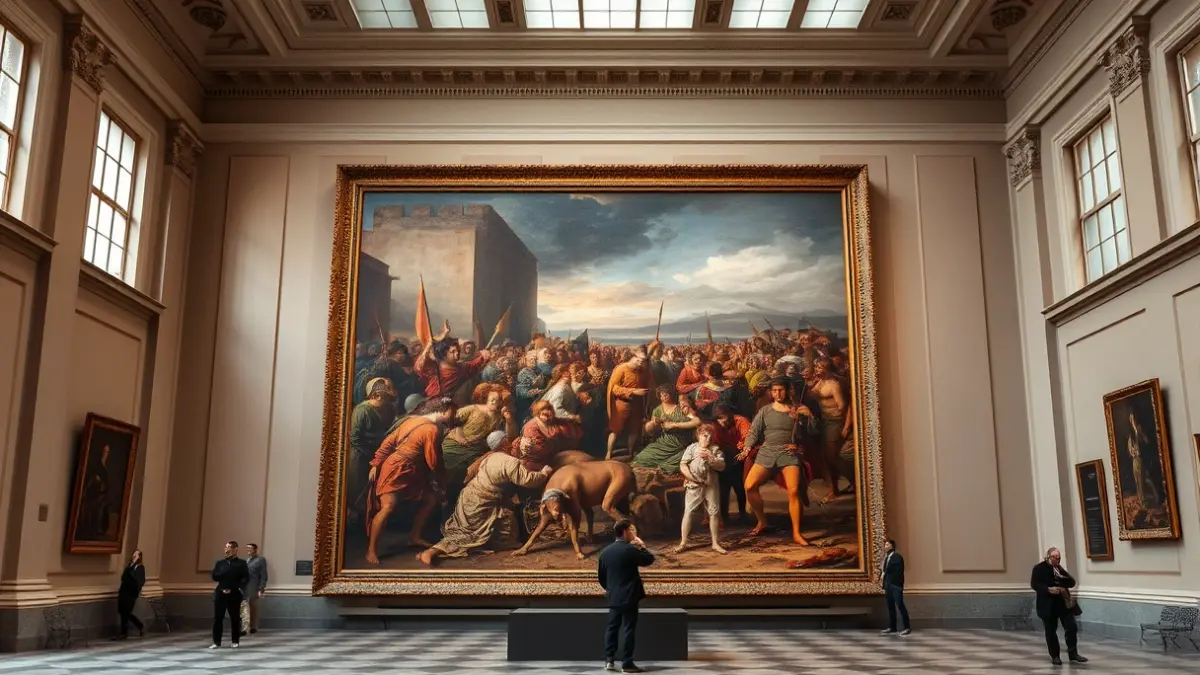
The Madrid art gallery has initiated a new museum proposal this Monday, aiming to highlight a single piece. The initiative begins with the exhibition of The Year of Hunger in Madrid, a painting by José Aparicio from 1818, which can be seen in room 66 of the Villanueva building.
“"To invite the viewer to contemplate a work that, beyond its aesthetic merits, allows reflection on aspects of art history that often go unnoticed."
Although less known today, Aparicio's painting was once one of the museum's most acclaimed works. During the reign of Ferdinand VII, it even overshadowed figures such as Francisco de Goya and José de Madrazo, as explained during the exhibition's presentation. Aparicio's work was the first thought of to inaugurate this new exhibition format.
The canvas, measuring 315 by 437 centimeters, depicts a group of famished figures rejecting bread offered by French soldiers during the famine that struck Madrid between 1811 and 1812. When it was presented at the opening of the Royal Museum of Painting and Sculpture in 1819, it served as an allegory of “Spanish constancy” and unconditional loyalty to the absolutism of Ferdinand VII.
The reconstruction of its original location in the museum, carried out in collaboration with the Complutense University of Madrid, has allowed for a deeper understanding of the institution's foundational episode. This work has also brought to light the ideological toll imposed by Ferdinand VII's absolutism in a space that was then his property.
From 1872, the annexation of the Museo de la Trinidad to the newly nationalized Museum of Painting and Sculpture necessitated a reorganization of collections and the discarding of works that did not fit the new selection criteria. Aparicio's painting was one of those affected by this purge, which responded to new aesthetic and political sensibilities far removed from Fernandine absolutism.