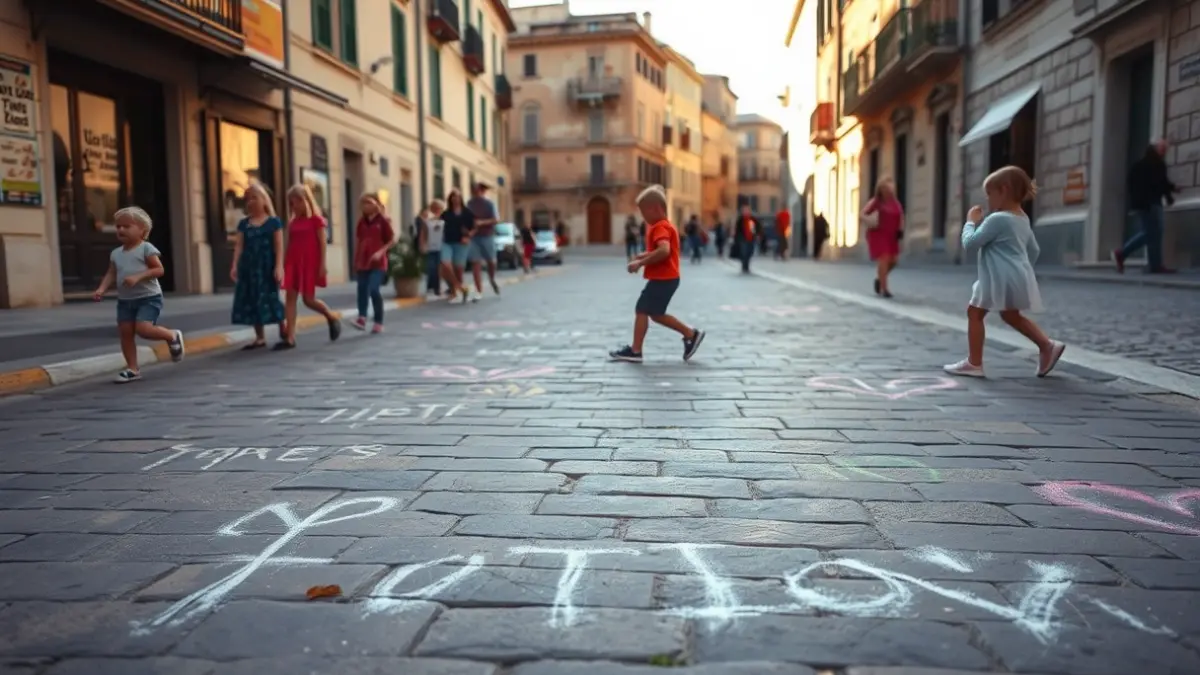
In the past, Madrid held a unique charm, imbued with the scent of dust and sun-warmed stones. Children's voices echoed in courtyards and alleys, while squares vibrated with life and half-open gates invited imagination. Grandmothers watched from windows, and children transformed every corner into a fantasy kingdom. Back then, no grand objects or screens were needed; artificial light could not compete with the beauty of a sunset over an ochre facade.
With just a piece of chalk, a rope, some marbles, and a worn spinning top, afternoons stretched endlessly. Traditional games were not mere pastimes but the innate language of childhood. Streets became play areas, squares turned into imaginary worlds, and every laugh found an unending echo.
Among the favorites was hopscotch, quickly drawn on the ground. A few crooked lines and a carefully chosen stone were enough to bring the game to life. Jumping from one square to another became a silent challenge, a balance between concentration and lightness, under the watchful eyes of other children.
Nearby, the spinning top twirled with a hypnotic charm. The art of launching it, learned with patience, became a source of pride when it finally spun perfectly. That continuous movement created a suspended moment where everything else seemed to stop.
Marbles, bright and colorful little treasures, held stories of victories and defeats. Children leaned towards the ground, drew invisible boundaries, and aimed with precision, in a game that combined skill and luck. The sound of the rope hitting the ground marked the rhythm of skipping rope, with songs accompanying each jump, creating a shared melody that united, made them laugh, and encouraged them to start over.
Hide-and-seek came alive between alleys and squares, where every corner became a refuge and every chase a moment of tension. The silence before being discovered, the accelerated heartbeat, and the final escape transformed the game into a small adventure. Tag, a version of catch, was pure energy, requiring only space and a desire to move. And then there was 'el pañuelo' (the handkerchief game), with teams lined up and the handkerchief in the center, symbolizing a brief but intense challenge, played with utmost seriousness.
Although Madrid remains a vibrant city, the way of playing has evolved. The digital age has introduced new forms of entertainment and languages, from virtual worlds to interactive devices and realities linked to contemporary gaming. This transformation is not a loss but an adaptation. Tools and contexts change, but the human need to play, create, and imagine remains unaltered.
However, when recalling those traditional games, a feeling lingers in the air: the distant echo of a laugh or the image of chalk drawing lines on the ground. In these simple gestures resides a collective memory of presence, real light, and shared time. In those distant afternoons, Madrid was not just a city; it was a large open-air home, where every square held the soft and unforgettable heartbeat of childhood.