On April 10, 1865, Madrid was the scene of an event that, although often relegated in historical narratives, proved fundamental to understanding the evolution of civic consciousness in the capital. The so-called Night of San Daniel transcended a mere student protest, becoming the turning point where the street acquired an unprecedented political significance.
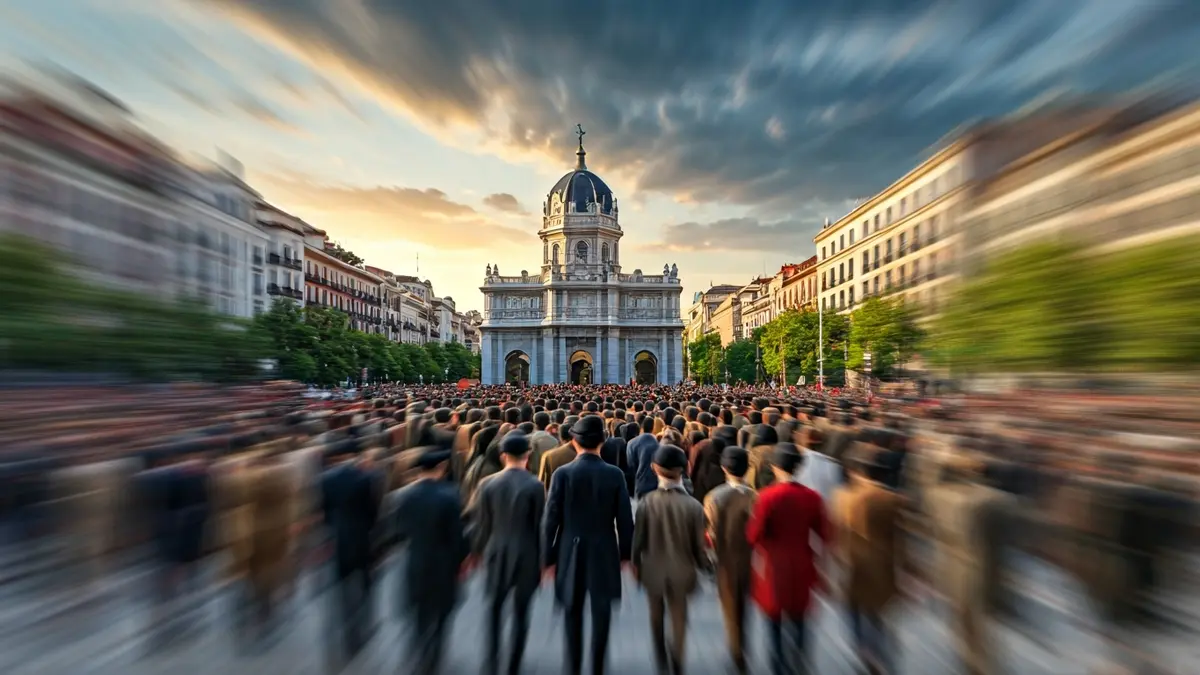
Until then, intellectual and political debate in Madrid primarily took place in closed circles, such as cafes and tertulias. However, on that day, students from the Central University decided to take their demands to the public sphere, motivated by the dismissal of a professor and a deeper social discontent that could no longer be contained.
Madrid no longer whispered. Madrid debated openly.
The response from Ramón María Narváez's government was energetic and violent. The repression in Puerta del Sol resulted in deaths and injuries, but, beyond the pain, it etched into the collective memory the certainty that public protest carried real consequences. Nevertheless, this night not only generated fear but also opened a new avenue for citizen participation.
From that moment on, the street began to consolidate itself as a vital space for political expression, a place where citizens could intervene, influence, and, if necessary, challenge the established power. This transformation, although gradual and not without obstacles, was constant and set a significant precedent.
Decades later, in April 1931, Madrid would experience another decisive moment. In the days leading up to the municipal elections on April 12, the city was immersed in a palpable atmosphere of tension and expectation. Political discussions had transcended private spheres, occupying the streets, squares, and cafes with renewed intensity.
This change cannot be understood without acknowledging the seed planted in 1865, which over time germinated into a collective consciousness. The proclamation of the Second Republic on April 14, 1931, was not an isolated event but the culmination of a process in which the street had progressively gained prominence as a political stage. Puerta del Sol, in this sense, emerges as a symbol connecting both historical moments: the place of repression in 1865 and the space where, years later, citizens would visibly express their will for change.