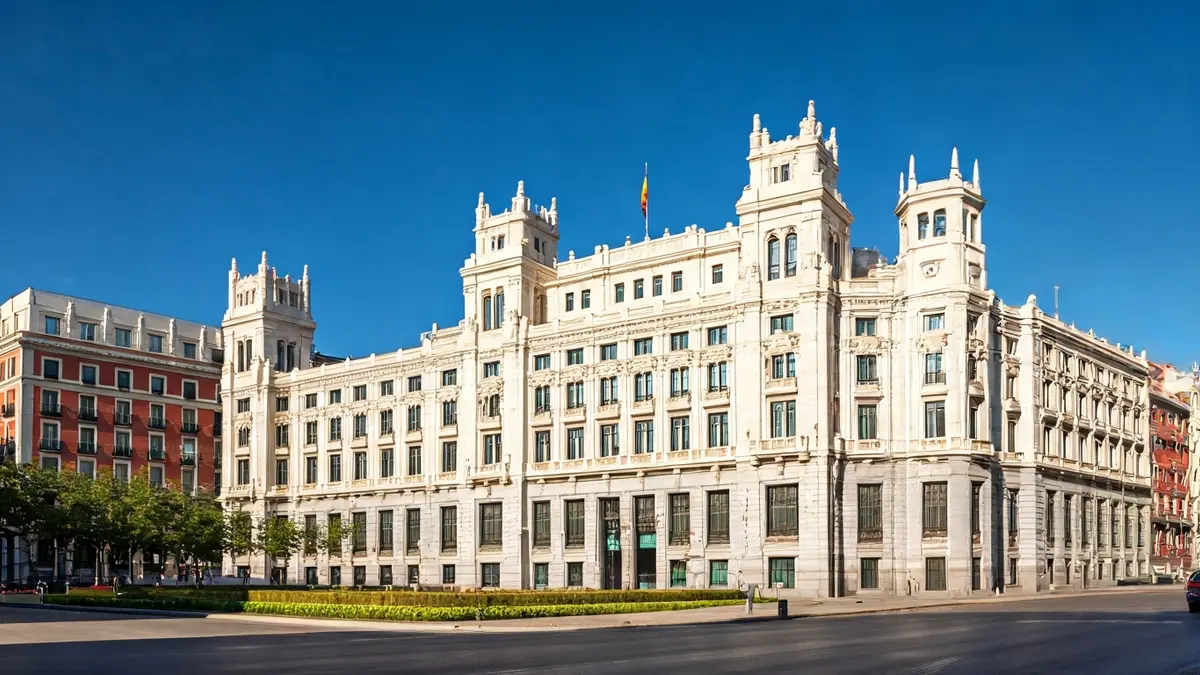
Amidst today's dynamic financial landscape, the Bank of Spain building in Madrid exudes remarkable tranquility. Strategically positioned at the intersection of Alcalá Street, Plaza de Cibeles, and Paseo del Prado, this property is not only an architectural landmark but also holds the distinction of having the highest economic activity tax in Spain.
The original construction, designed by Eduardo Adaro and Severiano Sainz de la Lastra, was inaugurated in 1891. Featuring an eclectic style with Neo-Renaissance influences, the building has undergone several expansions throughout the 20th century to accommodate the institution's growth, transforming into the imposing financial palace known today.
The Bank of Spain building is one of Madrid's most unique: it occupies an entire block at the vertex of three major urban axes (Alcalá, Cibeles, Paseo del Prado) and has grown in phases from its initial inauguration in 1891 to its current configuration.
One of the most notable historical anecdotes of the Bank of Spain dates back to 1936, at the beginning of the Spanish Civil War. At that time, the Republican government transferred the gold reserves to the USSR in exchange for military support, an operation known as the 'Moscow gold,' which has become one of the most controversial episodes in 20th-century Spanish economic history.
The Bank of Spain is part of an exceptional urban complex in Plaza de Cibeles, where other historic buildings converge, such as the Palacio de Cibeles (now CentroCentro), the Palacio de Buenavista (headquarters of the Spanish Army), and the Palacio de Linares (Casa de América). The iconic Cibeles Fountain, a celebration point for Real Madrid fans, completes this enclave of great historical and urban value.
Although the building is not regularly open to the public, the Bank of Spain organizes guided tours on specific dates, such as open house events. Inside, it houses the central bank's operational departments, its reserves, an extensive library specializing in economics and financial history, and a valuable art collection that includes works by Goya.