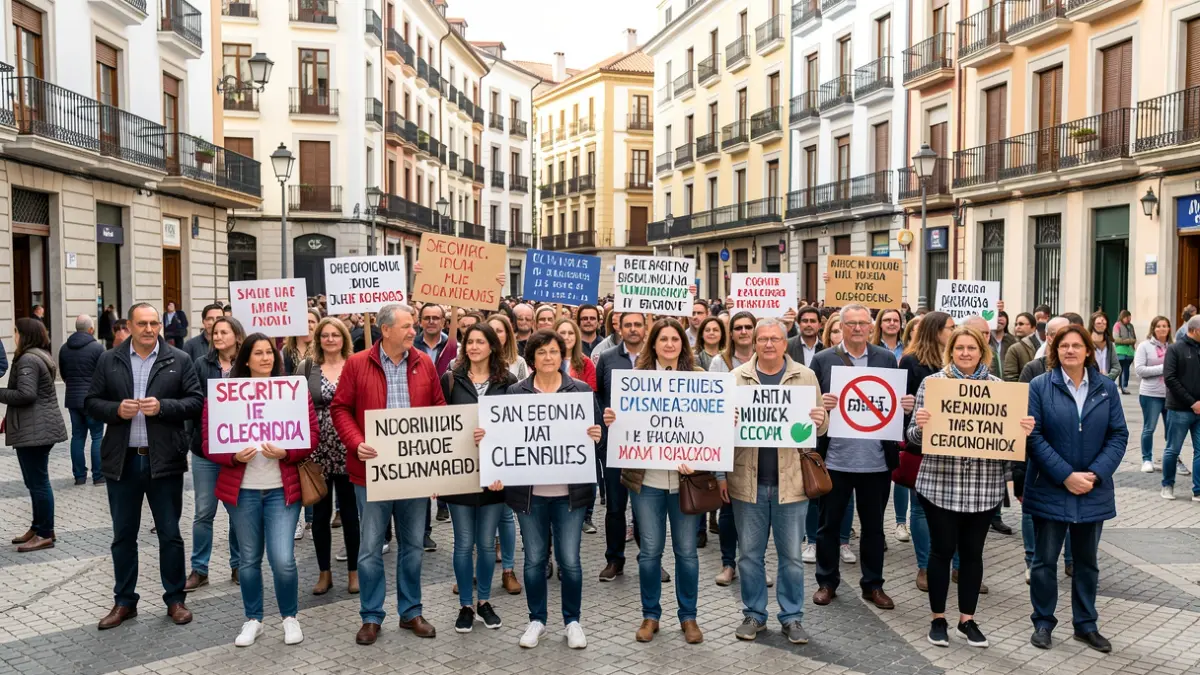
Residents denounce an increase in public drug dealing and consumption, public safety issues, notable deficiencies in street cleaning, and a lack of maintenance for public furniture and spaces. The march, organized under the slogan 'For a dignified, cared-for, and respected neighborhood. No more drugs and drug houses. More security and cleanliness. We want solutions,' aims to highlight local discontent over what they consider institutional neglect.
The mobilization will begin at 7:30 PM and will proceed through several main streets in the Simancas and Gran San Blas areas. The route established by the organization will start at the roundabout on Calle Amposta, in front of the church of San Joaquín, and continue through Calle Amposta, Castillo de Uclés, Zayas, Zaratán, Zapardiel, and Zumel, returning to the starting point on Calle Amposta.
From the San Blas Neighborhood Platform, its spokesperson Vicente Pérez Quintana emphasized the urgent need for the Central Government, the Community of Madrid, and the Madrid City Council to coordinate their resources. While acknowledging positive operational cooperation between the National Police and the Municipal Police in Parque Paraíso, he stressed that the problem cannot be solved by policing alone.
The spokesperson recalled an institutional meeting held on May 10, convened by the Government Delegation in Madrid, attended by the government delegate, the councilwoman president of the San Blas-Canillejas district, and the president of the Regional Federation of Neighborhood Associations of Madrid (FRAVM). He criticized the absence of representatives from the Community of Madrid, noting that the regional executive holds key responsibilities in health, education, and social services, which are fundamental to eradicating the root causes of addiction. Residents have also expressed surprise at the low activity of the East Addiction Treatment Center (CTA), a regional administration resource located in the district.
The FRAVM, which supports the call, reiterated the need for a permanent tripartite table. Its president, Jorge Nacarino, criticized the lack of a unified plan from the three administrations: the Central Government for suspending the renewal of the National Drug Plan agreement; the Community of Madrid for insufficient funding for centers like the CTA and street-level addiction services; and the Madrid City Council for the inadequacy of Madrid Salud programs.
Citizen entities agree that the Simancas and Gran San Blas neighborhoods are among the most vulnerable in the capital, requiring an urgent budget increase focused on health, education, and social inclusion measures, rather than solely on reinforcing street security personnel.