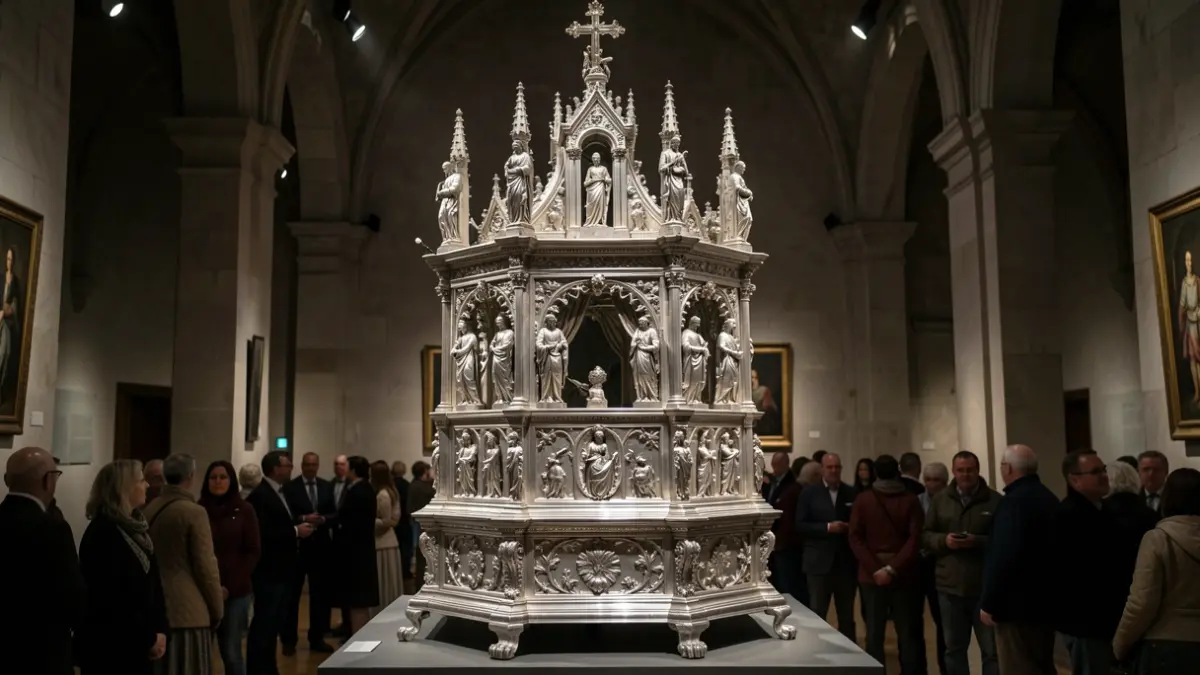
The liturgical procession will take place in front of the Palacio de Cibeles as part of the pontiff's visit to the capital, scheduled from June 6 to 9. The monstrance, a valuable silver piece owned by the municipality and linked to this festival since the 16th century, will occupy a prominent position in the ceremony.
After communion, the consecrated host will be placed in the monstrance, which will be positioned at the center of the altar. The Pontiff will then deliver the post-communion prayer, incense the Blessed Sacrament, and begin the procession along Alcalá Street towards Gran Vía, before returning to Cibeles. At the end, Pope Leo XIV will again incense the Blessed Sacrament, deliver a final prayer, and impart the blessing.
This unique piece, crafted in silver between 1568 and 1574 by silversmith Francisco Álvarez at the behest of the City Council during the reign of Philip II, is notable for not belonging to any religious institution but directly to the Madrid council. It is currently housed in the chapel of the Madrid History Museum, following restoration and cleaning completed in November 2024.
The structure of the processional monstrance comprises three parts: the base, the seated monstrance, and the portable monstrance. The first two, in Renaissance style, were created by Francisco Álvarez, featuring classical architectural forms and eucharistic decoration. The outer shrine of the base consists of eight Corinthian columns and figures of evangelists, while the seated monstrance, shaped like a double shrine, includes scenes such as the Last Supper. The sun monstrance or portable monstrance, from the 19th century, made by Francisco Moratilla, is intended to hold the Eucharist.
The history of the monstrance is intrinsically linked to the Corpus Christi procession in Madrid. In the late 16th century, the procession started from the church of Santa María and traversed emblematic spaces like the Plaza Mayor, the convent of San Felipe, and the old Alcázar, with the participation of confraternities, brotherhoods, the clergy, the City Council, and state representatives, as well as popular elements. The piece has survived thefts, such as the one in 1854 at the Casa de la Villa, where several valuable items were stolen.