
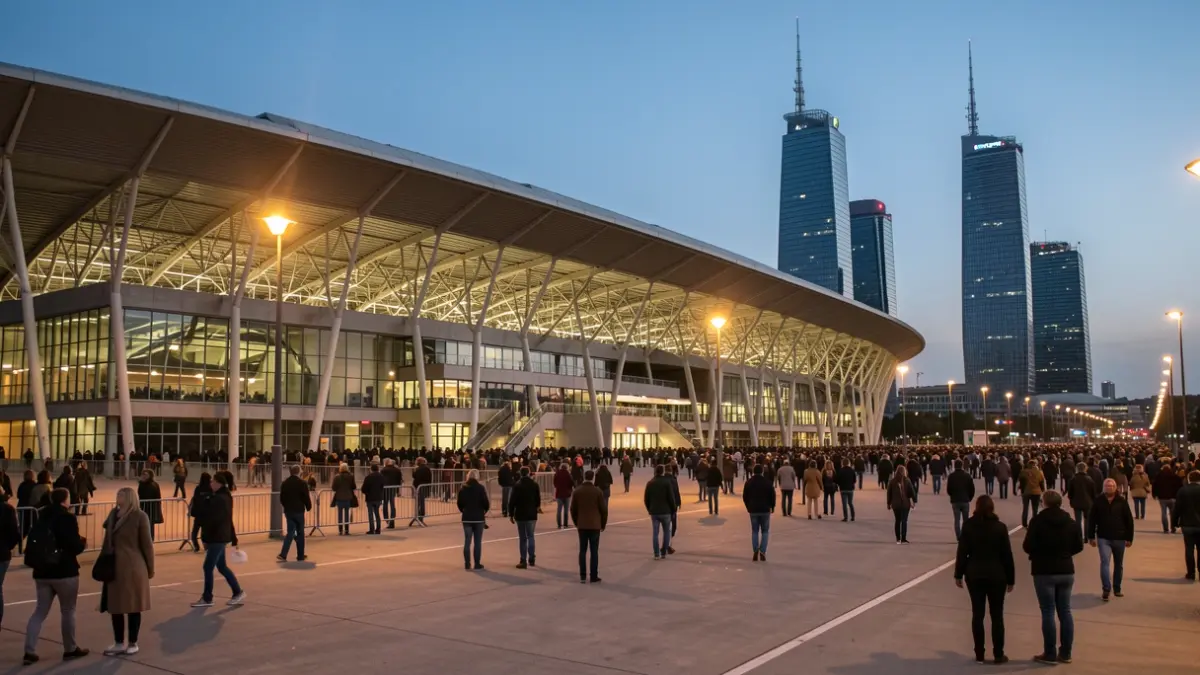
The impossibility of holding continuous large-scale events at the Santiago Bernabéu due to noise and licensing issues has reignited debate on the city's cultural programming. An opposition candidate for the club's presidency, Enrique Riquelme, has proposed a project for the Valdebebas grounds that includes a basketball pavilion, thus reviving the event tradition of the old Real Madrid Sports City pavilion.
This original pavilion, inaugurated in 1966 and later renamed Pabellón Raimundo Saporta, was home to the club's basketball section until its demolition in 2004 following the rezoning of the land for the construction of the Cuatro Torres Business Area. For over twenty years, the venue hosted concerts with a capacity of between five and seven thousand people.
In the seventies, the pavilion became a stage for international artists. In 1977, the Nueva Trova Cubana, featuring Pablo Milanés and Silvio Rodríguez, performed for thousands. The following year, Eric Clapton gave a concert that led to incidents due to attempts to enter without tickets, culminating in police charges. Figures like Frank Zappa and Eric Burdon followed.
The pavilion's history was also marked by protests and sound issues. In 1989, there were incidents related to ticket reselling, and in 1980, Iggy Pop's concert had limited attendance and sound problems. That same week, Julio Iglesias held a charity concert. In 1981, The Clash performed for over 7,000 people.
Hard rock had a significant presence. In 1979, Rory Gallagher performed, followed by Rainbow in 1982. AC/DC, with Brian Johnson as the new vocalist, played in 1981, as did Motorhead. In the following years, the stage rocked with Judas Priest, Dio, Helloween, and Manowar.
Spanish rock also left its mark. The album Rock and Ríos by Miguel Ríos, recorded live at the pavilion in 1982, became the best-selling Spanish rock album. That same year, Leño filled the venue. In 1984, Barón Rojo immortalized their live performance with the album Barón al rojo vivo. Later, in 1995, Extremoduro and Platero y tú performed.
Events like the 'Gran Fiesta del Estudiante y la Radio' of the early eighties, with 24-hour musical marathons and the participation of Radio 3, brought together figures such as Minister Javier Solana and Mayor Enrique Tierno Galván, along with numerous bands.
In the nineties, despite its age, the pavilion hosted major names. In 1997, Blur performed during the brit-pop boom, and that same year, The Offspring also played. However, the decade's most significant concert was by Nirvana on February 8, 1994, the band's last performance in Spain, just two months before Kurt Cobain's death.
The Pabellón del Real Madrid, with its intermediate capacity and good accessibility, served a similar function to the current Palacio de Deportes, acting as a venue for mid-level concerts and major tours before its demolition.


