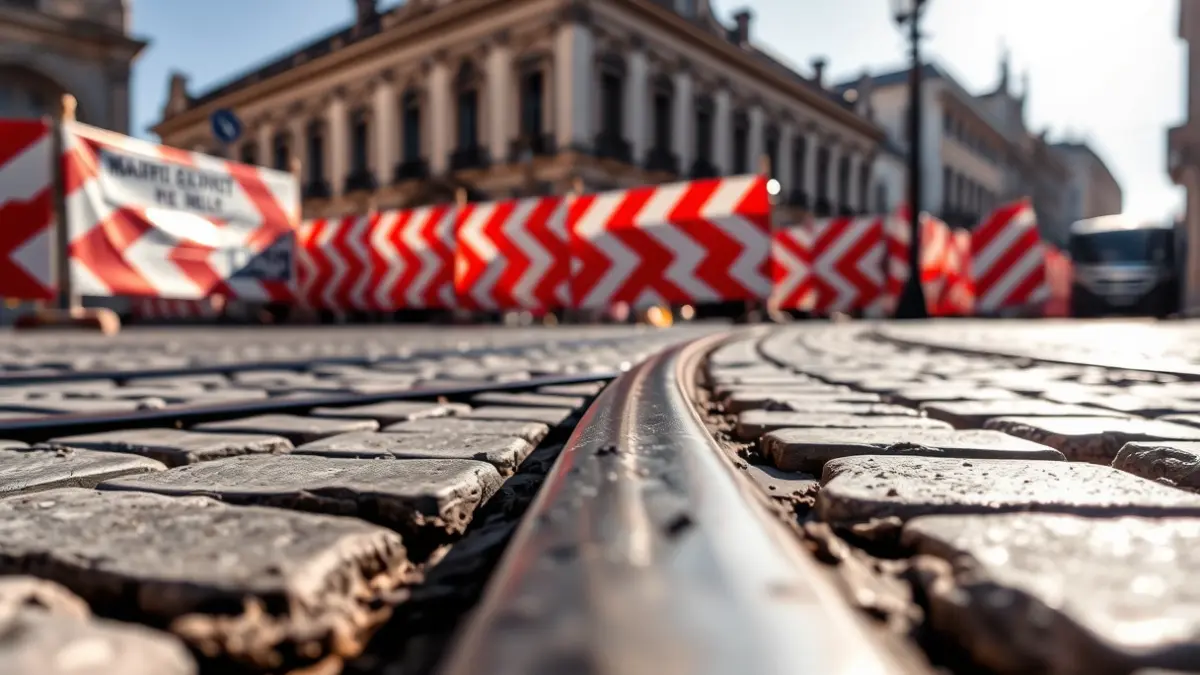
The discovery of these remains, made during the rehabilitation works in the area, generated considerable public interest and revived the memory of a transport system that was part of Madrid's urban landscape until its disappearance in the 20th century.
“"We understand that in the current project it is not easy to fit this musealization because it would substantially alter the planned design."
According to the Madrid City Council, technical reports prepared by the Community of Madrid conclude that these remains do not have specific heritage protection, allowing for their dismantling. The decision responds to the need not to alter the ongoing urban project, as explained by Deputy Mayor and municipal spokesperson, Inma Sanz.
The rails will be removed through a controlled process to avoid damage, and subsequently, the most suitable location for their exhibition will be sought. Although their historical value has not been considered relevant from a heritage perspective, the Council emphasizes their symbolic importance and seeks to highlight it in a more appropriate setting, possibly in a museum related to transport or the city's history.
“"It has an almost emotional value for the people of Madrid."
This decision aligns with the recommendations of the General Directorate of Cultural Heritage, which suggested the extraction of the remains and their subsequent musealization. In this way, the City Council chooses to preserve a part of urban memory without compromising the development of the transformation project for the axis between Cibeles and the Puerta de Alcalá.
For now, the Madrid City Council has not provided further details on the exact location where the rails will be transferred, although the municipal government assures that it will be a space that allows their history to be contextualized and public access facilitated. Meanwhile, rehabilitation work continues in the area.