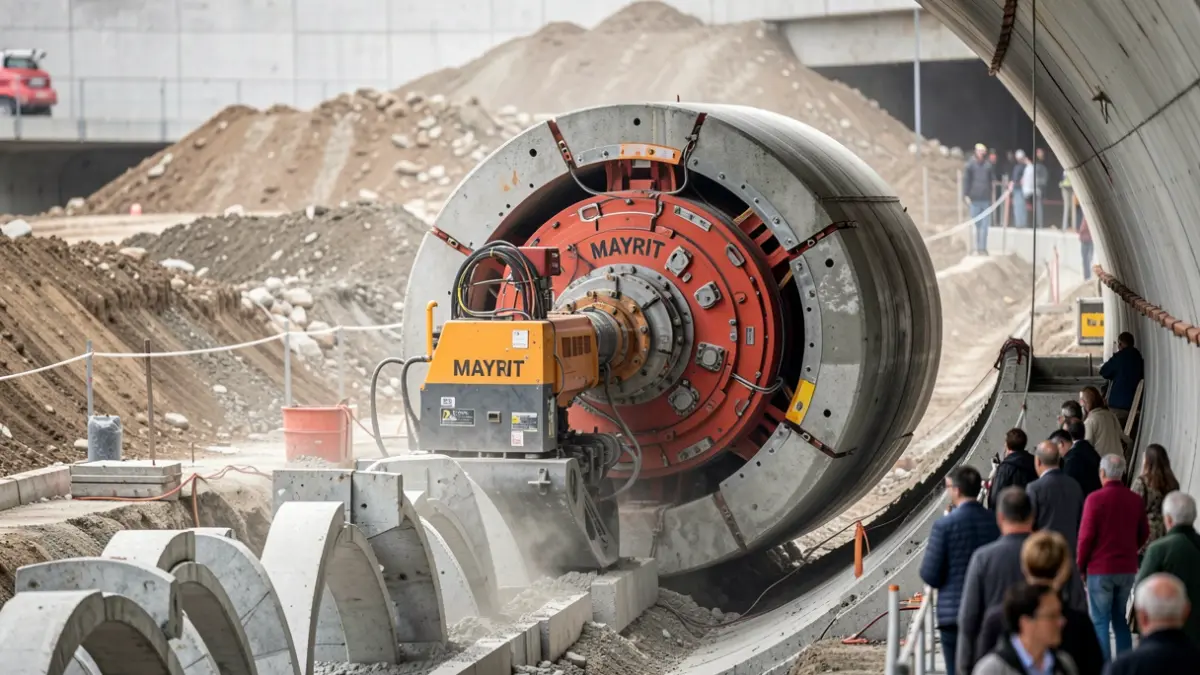
The Community of Madrid is maintaining a steady pace in the expansion works of Metro Line 11. The tunnel boring machine Mayrit operates 24 hours a day, seven days a week, to excavate the new tunnel and reach the next milestone: the junction at the future Palos de la Frontera station.
After successfully completing the section between Comillas and Madrid Río, the machine continues drilling as planned, a crucial step in shaping the future diagonal Metro line, set to become a main mobility axis for the region.
Since its start on March 26, Mayrit has excavated over 2,500 meters, installed nearly 1,500 concrete rings, and removed more than 170,000 cubic meters of earth, a volume equivalent to about 70 Olympic swimming pools.
The tunnel borer advances several meters underground with a complex engineering system ensuring maximum safety, while thousands of Madrileños move above the route. The process combines drilling with immediate installation of concrete rings, stabilizing the infrastructure as fast as excavation progresses.
Operations are organized in permanent shifts with engineers, operators, mechanics, surveyors, geologists, logistics specialists, and security personnel continuously supervising all systems.
The next objective is to perform the Palos de la Frontera junction, a delicate operation requiring precision of a few centimeters after hundreds of meters underground in the capital.
Work is carried out under an exhaustive monitoring system that controls the tunnel boring machine's behavior, ground response, and buildings above in real-time, ensuring the highest safety standards.
While excavation continues underground, surface works are simultaneously advancing on the future stations of Comillas, Madrid Río, Palos de la Frontera, Atocha, and Conde de Casal, along with associated infrastructure, optimizing timelines and maintaining a high execution rate.
With this permanent deployment of human and technical resources, the Community of Madrid is driving one of the largest civil engineering projects currently underway in Spain, a strategic infrastructure that, like Mayrit itself, does not rest in building the region's mobility future.