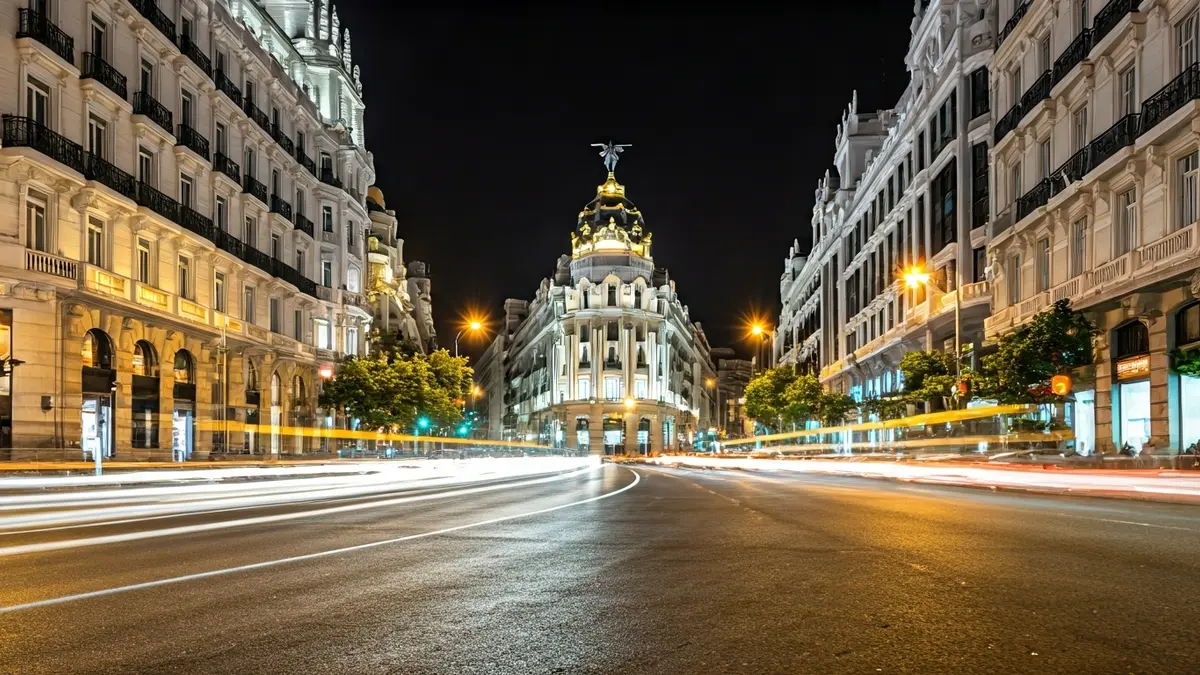
The construction of Gran Vía, which spanned over four decades from 1910 to 1952, involved the demolition of more than 300 buildings and the relocation of thousands of residents. This ambitious urban project, connecting Alcalá Street with Plaza de España, permanently altered the urban landscape of central Madrid.
Today, Gran Vía is an unmissable landmark in Madrid, renowned for its eclectic early 20th-century architecture, lively nightlife, and prominent musical theater offerings. The coexistence of luxury shopping and mass tourism positions it as a unique enclave globally.
The Gran Vía of the 21st century is both a top-tier tourist attraction and a complex urban problem. Tourist overcrowding, commercial monoculture (international clothing and restaurant chains), and the loss of local businesses are real issues that the City Council is trying to address with various urban planning measures.
The development of Gran Vía was divided into three main phases, each with a distinct architectural style. The first section, built between 1910 and 1915, is characterized by ornate buildings with French, Viennese, and Spanish influences, notably including the Metrópolis Building, the Palacio de la Prensa, and the Grassy Building.
The second phase, from 1915 to 1929, exhibits a more 'New York' feel, with the Telefónica Building as its prime example. Inaugurated in 1929, it was Spain's first skyscraper at 81 meters tall and the first in Europe with a metallic structure, its American rationalist style contrasting with the earlier eclecticism. The final stage, from 1929 to 1952, culminated in more modern and monumental structures like the Edificio España and the Torre de Madrid, with the Edificio España being the tallest in the country at the time and now home to the Riu Plaza España hotel.
Despite current urban challenges, such as tourist overcrowding and commercial homogenization, Gran Vía maintains its dynamism. It is the epicenter of musical theater in Spain, hosting major international productions that liken it to London's West End or New York's Broadway. The recent renovation of Plaza de España has improved pedestrian connectivity, further enriching the experience of this emblematic boulevard.