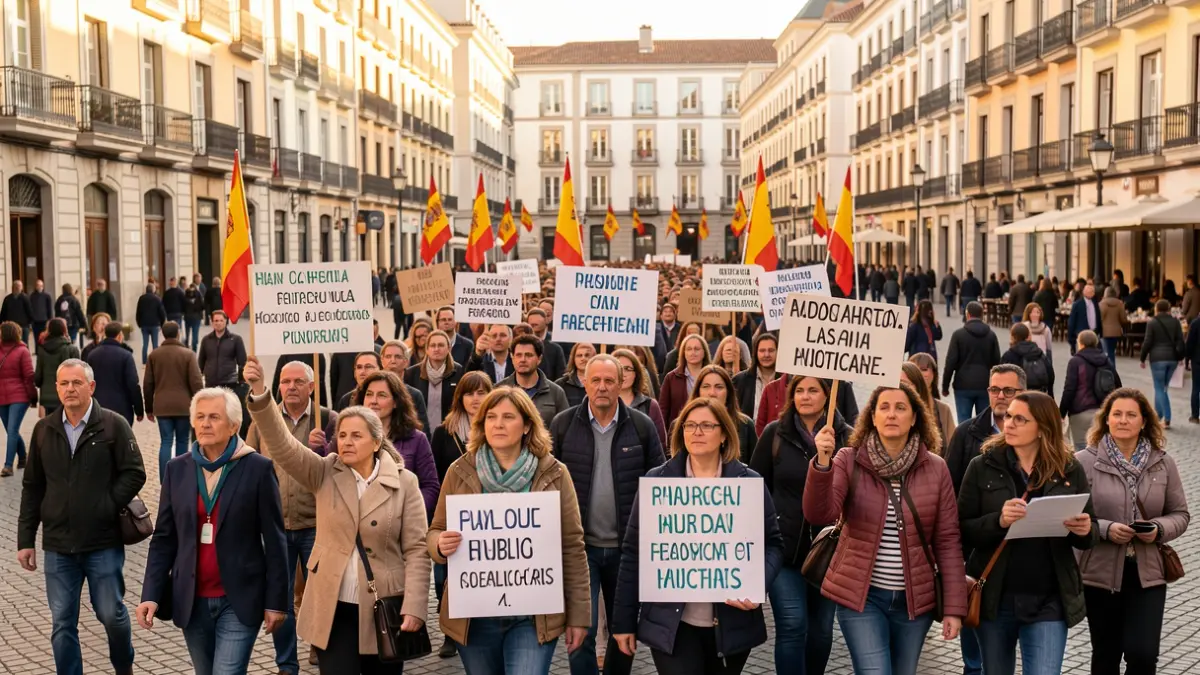
Thousands of Madrid residents will take to the streets this Sunday, May 31, to defend Public Healthcare, in a march called by neighborhood platforms denouncing its deterioration and demanding its protection.
Madrid will host a new mobilization this Sunday in defense of Public Healthcare. The protest, called by the Platform of Neighbors and Neighborhoods for Public Healthcare, will bring together over a hundred associations, platforms, and neighborhood entities under the slogan “Saving our Public Healthcare is saving us all”.
The march will revive the format of large healthcare mobilizations from recent years, with four columns departing at 12:00 PM from Atocha, Colón, Sevilla, and Plaza Dalí-Felipe II to converge at Plaza de Cibeles. This is the fifth call with this model promoted by this neighborhood space, following those held in November 2022, February 2023, and May 2024 and 2025.
The organizers denounce the deterioration of the Madrid healthcare system and reject a model that, in their view, favors privatization. They argue that healthcare should be a guaranteed right, not a business dependent on individual financial capacity.
“"Our health cannot be the spoils of any private company. Every euro diverted from the public to the private is a euro stolen from the care of our elders, from the future of our children, and from the safety of the entire population. Healthcare should not generate economic profits; it should generate social well-being."
The mobilization will call for the safeguarding of Public Healthcare, the repeal of laws that permit healthcare privatization, and the reversal of privatized assets. The objective is to prevent the healthcare system from being “hijacked” and handed over to “private interests”.
One of the main focuses of the protest will be the state of Primary Care, whose “dismantling” the organizers denounce. They demand strengthening health centers as the entry point to the healthcare system and call for at least 25% of the healthcare budget to be allocated to this care level.
“"Our health centers are the first line of defense. We cannot allow waiting times to see a family doctor to be counted in weeks, nor for out-of-hospital emergencies to be empty boxes without sufficient staff."
The march will also serve to demand better working conditions for healthcare professionals, such as the implementation of a 35-hour work week in the Community of Madrid and the recognition of dignified conditions for all sector workers.
“"We cannot continue to drive away talent while our healthcare system is left without staff. We demand dignified conditions for all professionals working in Public Healthcare. Caring for those who care for us is the only way to guarantee quality assistance."
The call comes amidst labor conflict in healthcare, marked by the intermittent indefinite strike called at the state level by doctors and physicians to demand a specific Framework Statute that recognizes the profession's particularities. Following several weeks of stoppages, another week of strike is planned between June 15 and 19.
The Department of Health has estimated the impact of the first 26 strike days by doctors and physicians since December on Madrid's healthcare system at over 16.4 million euros, with 10,470 surgeries, 215,344 consultations, and 21,733 tests suspended.
Waiting lists will be another central point of the protest. The organizers describe them as a “disgrace” and argue that delays in tests, consultations, and surgeries push some citizens towards private insurance.
“"Health cannot wait. The systematic delay in tests, specialists, and surgeries is a silent way of pushing citizens towards private insurance. It is a covert privatization that creates first- and second-class patients based on their bank account."
According to the latest available data, corresponding to April, the surgical waiting list in the Community of Madrid included 107,208 people, with an average delay of 46.65 days. Another 728,917 people were waiting for a first appointment in external consultations, with an average of 61.17 days, and there were 186,810 pending slots for diagnostic and therapeutic tests, with an average delay of 53.9 days.
The platform also calls for increased healthcare funding for the Community of Madrid, which it defines as the region with the highest population growth and, at the same time, the lowest per capita healthcare investment. Healthcare spending per inhabitant in Madrid stands at 1,424 euros, compared to regions like Asturias, where it reaches 2,301 euros.
Furthermore, they reject attributing the system's deterioration to the migrant population. “The effects of this disastrous management are attempted to be covered up by blaming the migrant population (who also work, contribute, and pay taxes) for the deterioration, lack of resources, and saturation of public healthcare,” they state.
With this new march, the neighborhood platform seeks to maintain social pressure and initiate a “hot spring” in defense of Public Healthcare. The organizers call for citizen mobilization and assert that the public healthcare system is “the greatest asset of the people of Madrid”.
“"Because we do not want access to healthcare to depend on what we have in our wallets. Because we want the right to health to be for everyone. Because the public is the only thing that makes us equal."