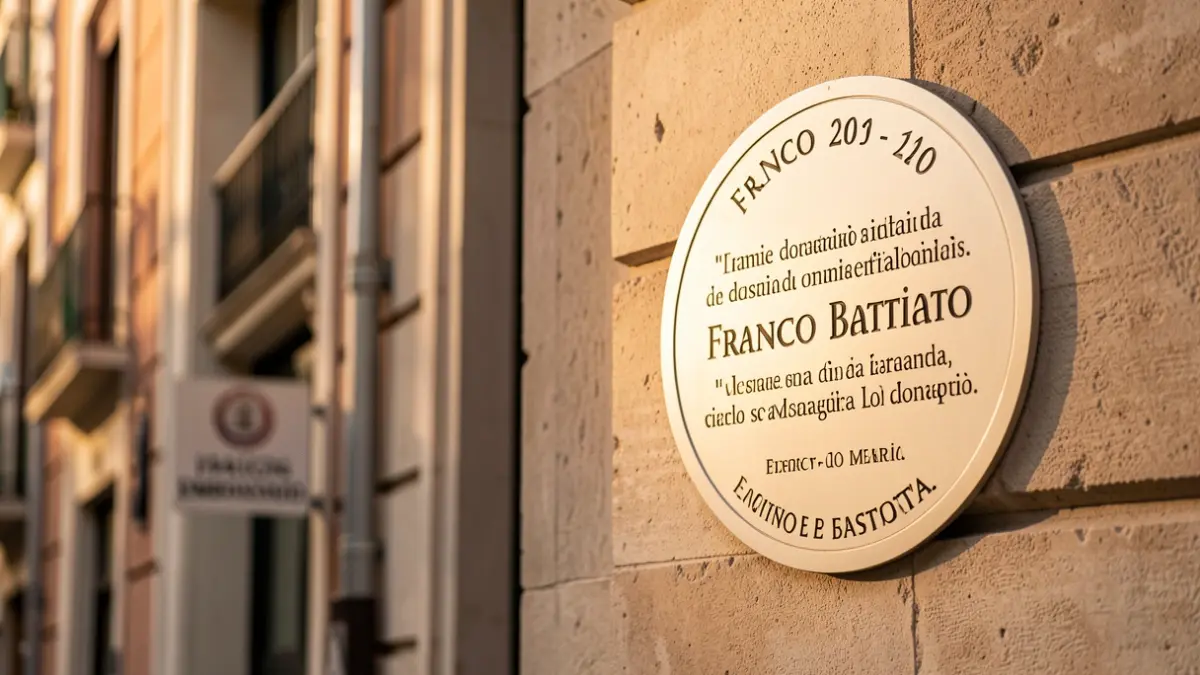
The city of Madrid has paid tribute to the renowned Italian singer-songwriter Franco Battiato (1945-2021) by installing a commemorative plaque on Juan Bravo street, next to the Italian Embassy. This gesture acknowledges the artist's deep connection with the Spanish capital, evoked in the Spanish version of one of his most emblematic songs.
The inauguration ceremony was attended by the delegate councilor for Culture, Tourism, and Sport, Marta Rivera de la Cruz, and the councilwoman president of the Salamanca district, Cayetana Hernández de la Riva. The Italian Ambassador to Spain, Giuseppe Buccino, was also present at the event, underscoring the cultural significance of the tribute.
Rivera de la Cruz highlighted that Franco Battiato used music as a bridge between culture, thought, and emotion. The circular plaque includes the artist's birth and death dates, as well as a quote from his hit song "Centro di gravità permanente," which propelled him to number one on the Spanish charts and symbolizes the search for serenity in a constantly changing world.
Born and died in Sicily, Battiato began his career in the seventies, achieving international recognition in 1981 after winning the San Remo Festival with "Per Elisa." That same year, he released "La voce del padrone," which included the track "Cuccurucucù." His extensive discography also features hits like "Voglio vederti danzare" (1982), "E ti vengo a cercare" (1988), and "La cura" (1996), the latter considered the best Italian song of that year. In addition to his musical legacy, Battiato also explored his talents as a painter and film director with the movie "Perduto amor" (2003).