
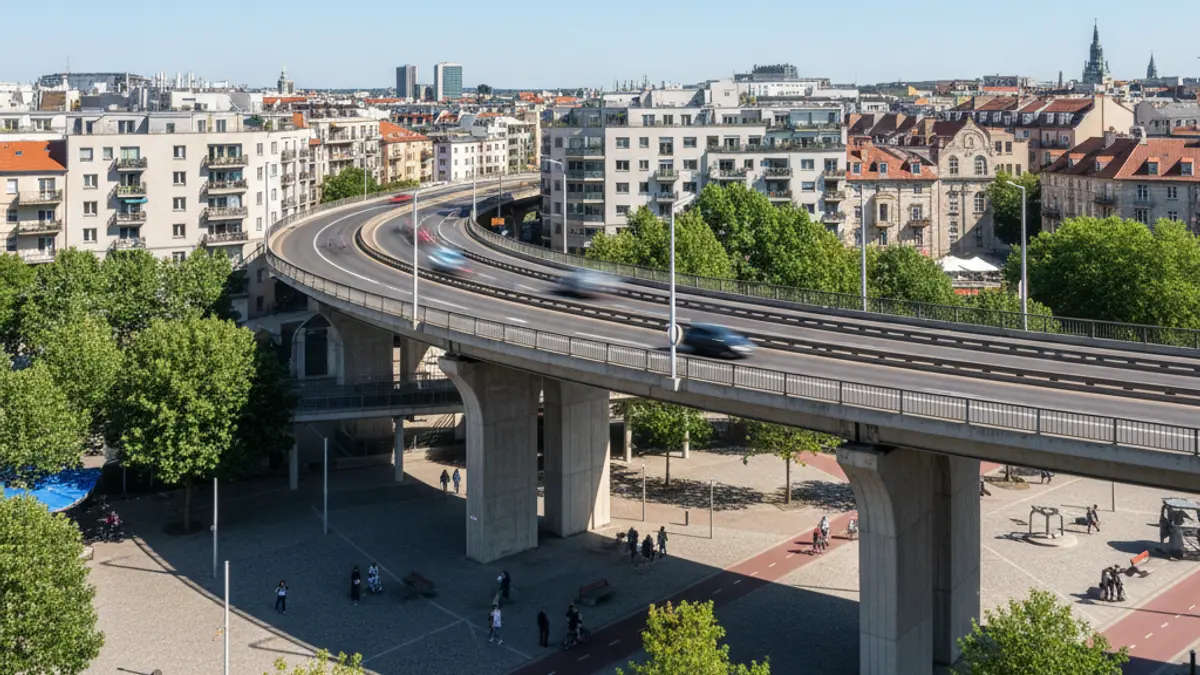
The intervention, named Vallecas Abierto (Open Vallecas), seeks to transform an area described as “degraded” and “a barrier that prevents adequate coexistence.” Despite this characterization, the reform does not include removing any of the 20 lanes dedicated to motorized traffic—eight on the upper level, six at ground level, and six underground.
“"300,000 vehicles circulate daily through this section, and this is what can be done to keep them moving."
Among the project's novelties is the pedestrianization of Monte Oliveti Street, which will add 3,770 square meters of pedestrian space. Additionally, a municipal facility will be built under the bridge, potentially housing a rehearsal room, as well as a space for Madrid Calle 30 and the Municipal Transport Company of Madrid (EMT). The plan also includes the installation of vertical gardens, the planting of 48 trees and thousands of shrubs, and the reorganization of EMT bus bays under the bridge.
The estimated investment for these works is 11.5 million euros, with a two-year execution period. Work is expected to begin “imminently,” with vertical garden installation starting in summer and completion by the first quarter of 2027.
“"Far from addressing the real problem of the Vallecas 'scalextric', the last one in Madrid, the City Council continues to ignore residents who have been demanding its dismantling for years. The solution to this inequality gap, to the thousands of exhaust pipes and noise, is to demolish it."
The proposal has drawn criticism from Puente de Vallecas residents, who have repeatedly called for the removal of this infrastructure, which they consider an artificial barrier since its installation in 1976. Neighborhood groups have pointed out that the 'scalextric' contributes to air and noise pollution, mobility issues, and insecurity in the area.