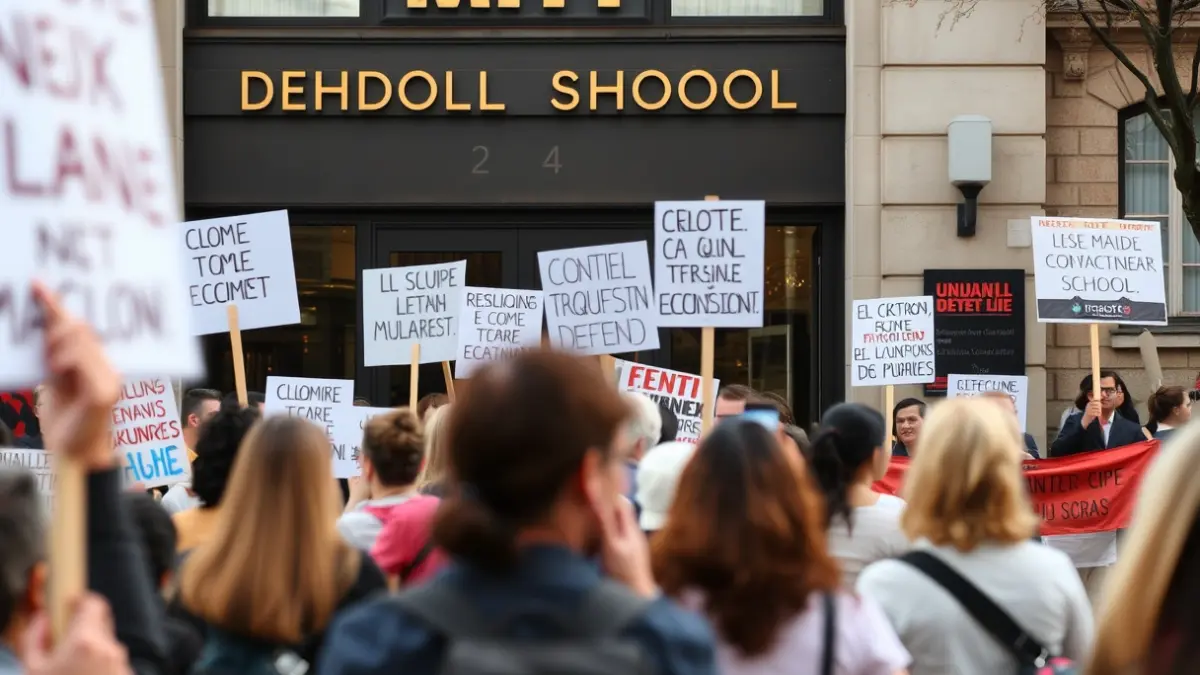
The Community of Madrid has unveiled the 'K.O. to Bullying' campaign, an initiative aimed at strengthening the fight against bullying in classrooms. The presentation event, held at CEIP Miguel Blasco Vilatela, coincided with a gathering of striking early childhood educators, who demonstrated outside the center.
A regional government councilor explained that the campaign seeks a “massive dissemination of all measures being implemented against school bullying.” The program is designed to offer solutions and guidance on how to act in potential cases, utilizing channels such as SociEscuela, action protocols, and new guides for teachers, students, and families. The goal was emphasized that “all schools should be safe centers” and that children “deserve respect and to grow up in a place without fear.”
For this initiative, the Community of Madrid has once again collaborated with a well-known fighter, who shares his personal testimony after having experienced bullying in his childhood. The campaign will be disseminated through various media such as television, radio, press, and posters in approximately 1,500 educational centers, aiming to reach around 500,000 students.
Among the highlighted resources is the 012 A tu Lado service, which offers psychological support and guidance to students, teachers, and families. The councilor encouraged the educational community not to be afraid and to contact 012 in any situation to seek help. Furthermore, it was noted that efforts against school bullying are yielding results, with a 5 percent decrease in cases, according to data from the regional Observatory, attributed to strengthened prevention and early detection.
The day concluded with a symbolic race in which the center's students participated to raise awareness against bullying, while from the school's boundary fence, a group of educators demonstrated with chants and whistles in defense of their working conditions.
“"If anyone has to promote this, it will be the Ministry of Labor"
In parallel to the presentation, a group of early childhood educators gathered to demand labor improvements, including salary increases, reduced ratios, and a national regulatory framework. The regional government councilor framed the mobilization as “a labor conflict arising from the lack of agreement in the collective bargaining agreement between representative unions and employers,” indicating that the matter “does not pertain to the Community of Madrid.” She assured that the regional government has maintained contact with the workers and is committed to providing information on negotiation progress. She also defended that the salaries of personnel directly dependent on the Community of Madrid are “much higher” than those under the agreement between workers and private companies, whose ultimate responsibility lies with the Central Government. The councilor criticized the role of some unions and organizing bodies, accusing them of acting with political interests, and affirmed that the Ministry would not engage in “political games.”