Digital transformation is part of our daily lives. Checking a restaurant menu from your mobile, visiting a museum with augmented reality, accessing digital content, or carrying out a procedure without leaving home are increasingly common actions. Everything seems faster and more convenient. But it is not always the case for everyone.
It is enough for information not to be readable with a screen reader, for a map to be difficult to interpret, or for a QR code to lead to inaccessible content for that experience to stop being simple. That is when a question arises: what is the point of innovating if a part of the population is left out?
At a time when artificial intelligence, the digitalization of services, and new forms of interaction are advancing at great speed, universal accessibility is also beginning to occupy an increasingly relevant place in that debate.
Universal accessibility begins long before technology
More than 22 years ago, Puntodis was born with a clear idea: a more inclusive society is also a society better prepared to innovate.
From its headquarters in Urduliz (Bizkaia), the company supports public administrations, companies, museums, tourist destinations, and other organizations to identify barriers that often go unnoticed. It analyzes spaces, services, processes, and communication channels to understand how people interact with them and detect what might be hindering that experience. Based on that diagnosis, it proposes strategies and solutions adapted to each reality.
The experience accumulated over these years has led Puntodis to incorporate universal accessibility from the early stages of each project. This approach allows for anticipating barriers and proposing solutions before the project is finished, when it is still possible to improve the experience of the people who will use it.
This working methodology brings together a multidisciplinary team, led by Jon Imanol Ibarra, CEO of Puntodis, and integrated by specialists in universal accessibility, design, communication, user experience, and technological development. The combination of these profiles allows each project to be approached from a global vision, where technology is understood as a tool at the service of people.
When experience turns into solutions
Over the years, Puntodis has collaborated with very different organizations, and that track record has allowed it to verify that many needs are repeated.
It does not matter if it is a museum, a restaurant, a customer service office, or a tourist destination. In the end, they all share the same goal: for information to arrive clearly and for anyone to be able to access it without barriers.
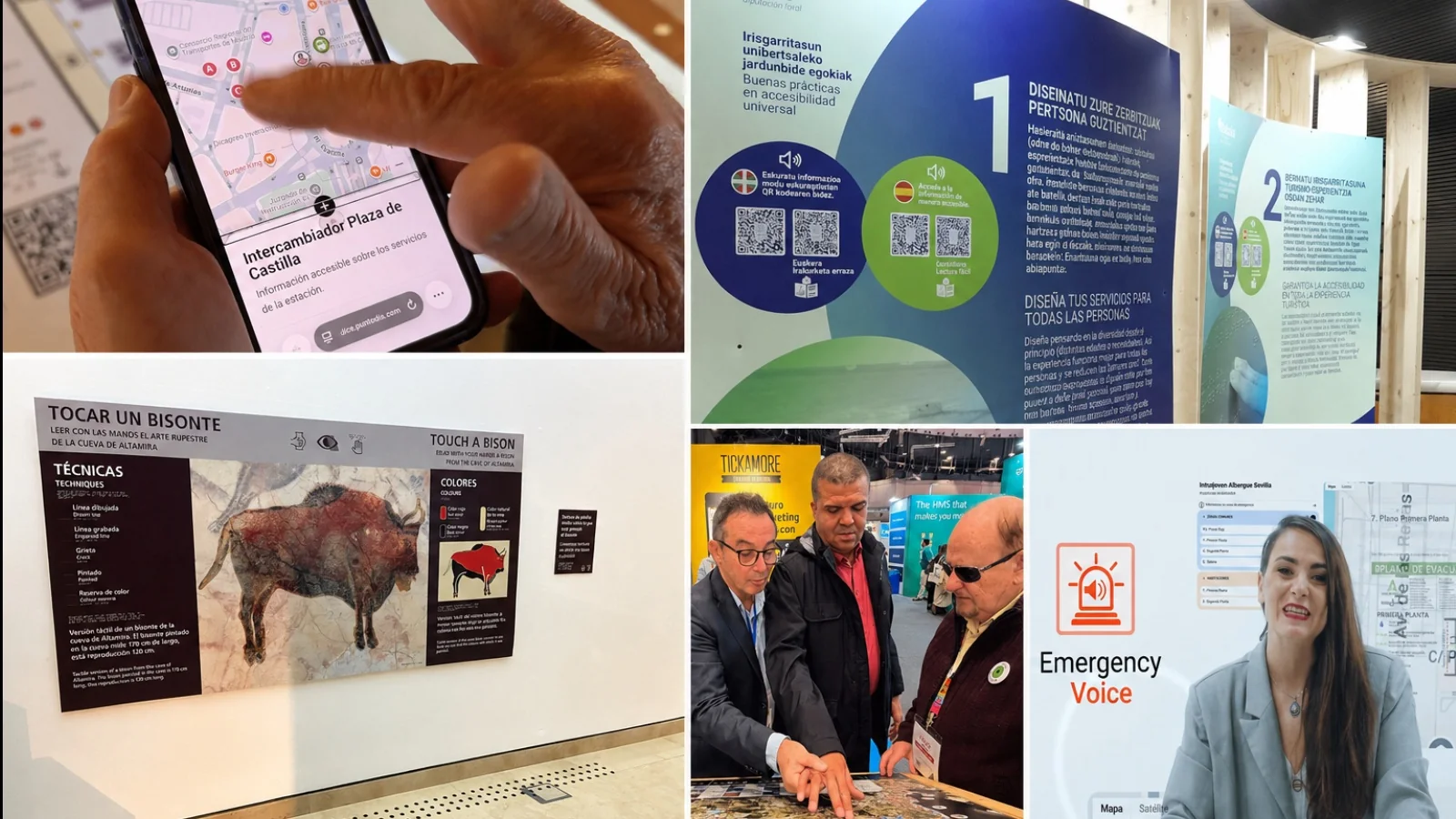
From that experience, the Familia Voice was born, an ecosystem of digital solutions developed by Puntodis to facilitate access to information through QR codes or web links that lead to accessible content adapted to each context.
Museum's Voice facilitates access to cultural heritage through accessible content. Map's Voice helps with orientation through accessible maps, routes, and tours, with information available in different formats to adapt to each person's needs. Chef's Voice transforms menus into multilingual digital experiences and incorporates information on allergens and other aspects of interest for each diner. Doc's Voice adapts any document to make it easier to understand and consult. Emergency Voice allows for knowing evacuation plans, protocols, and safety information in advance so that more people can act autonomously when the situation requires it.
Although they respond to different needs, all these solutions share the same approach: facilitating access to information in very diverse contexts.
Innovating with the end-user in mind
Practice shows that when a service is designed with a greater diversity of users in mind, the result is usually a clearer, more intuitive, and useful experience for everyone.
Better-structured information reduces errors. Content available in different formats expands access possibilities. And simpler communication makes it easier for each person to find what they need more quickly and autonomously.
In this context, universal accessibility has ceased to be understood solely as a regulatory issue to become, increasingly, an element that influences the quality of services, the user experience, and the relationship between organizations and people.
From Euskadi, Puntodis supports public and private entities on this path, combining universal accessibility consulting with the development of solutions adapted to the needs of each project.
Digital transformation will continue to incorporate new tools and new ways of accessing information. The challenge will be for this evolution not to leave anyone behind. Because, beyond technology, innovating also consists of expanding opportunities for access, participation, and autonomy.