Following the recent visit of Pope Leo XIV to the capital, political focus in the Community of Madrid has shifted to the air conditioning of educational centers. Families, teachers, and left-wing parties are demanding urgent measures against increasingly intense and early heatwaves, a long-standing demand that was debated again in the Assembly this Thursday.
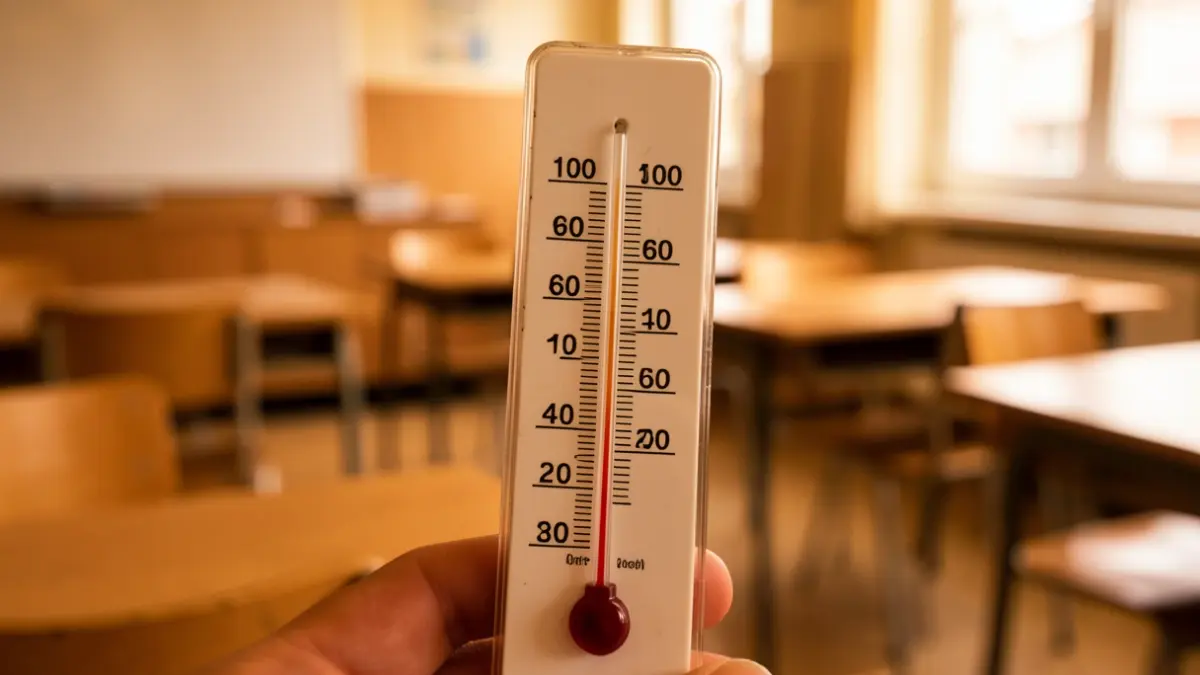
Más Madrid has presented a proposal to amend the Regional Law on Rights, Guarantees, and Comprehensive Protection of Children and Adolescents. The aim is to legally regulate the mandatory maintenance of stable temperatures, between 17 and 27 degrees Celsius, in schools and institutes. The initiative has the support of the PSOE, but abstention is expected from Vox and a predictable rejection from the People's Party, which has previously vetoed similar proposals.
During the Government Control Session, progressive forces advocated for allocating more public resources to acquire the necessary technical means to mitigate the effects of heat. The spokesperson for PSOE-M, Mar Espinar, directly questioned the president about her plans, suggesting that inaction stemmed from a lack of business opportunities. Meanwhile, the spokesperson for Más Madrid, Manuela Bergerot, urged a focus on the "real problems of Madrid residents" rather than the "limpet" of the papal visit.
“"The problem exists. The facilities are highly improvable. There are families who are right when they pick up their children sweating like chickens and wonder if they study in a dignified center. We recognize the problem, but not this solution."
The spokesperson for Vox, Isabel Pérez Moñino, indicated that her party "would not oppose" the proposal, considering it a "legitimate" demand, which will translate into abstention. The party's Secretary General, José Antonio Fúster, acknowledged the issue of "highly improvable" facilities but criticized the proposal as a "solution" that turns "every technical deficiency into a legal right."
The People's Party justified its stance by citing over 1,500 actions taken in recent years to improve conditions in schools and other public buildings, including awnings, pergolas, and facade renovations. According to President Isabel Díaz Ayuso, the government has acted on "72 percent" of the planned facilities, although she noted that collaboration with local councils is crucial.
The spokesperson for the Madrid Executive, Miguel Ángel García, recalled that the investment allocated to educational air conditioning will reach 80 million euros next year, assuring that they are "fully committed" to the issue. The Popular Party also argues that a "complete" regulatory framework already exists, considering the current initiative as a duplication of existing regulations.
Tensions are further heightened by previous statements from government members. The Minister of Education, Mercedes Zarzalejo, made the controversial remark "when it's hot, it's hot," while the Minister of Culture, Mariano de Paco, stated that "heat sharpens ingenuity," adding fuel to the debate.
Meanwhile, the 'Aprender Sin Calor' (Learn Without Heat) platform mobilized in front of the Assembly to demand educational centers "below 27 degrees and above 17." The goal is to pressure the regional Childhood Law to include the "obligation to allocate resources for sustainable air conditioning and thermal insulation of educational centers." A representation from the platform was expelled from the hemicycle after chanting "shame, shame" during the People's Party's intervention.
“"From the People's Party, it's the usual. Everything is no. We families do not have the feeling that anything has been done. Nor do they authorize anything to be done, because there are families willing to contribute from our own pockets for awnings, fans... It's like the dog in the manger."