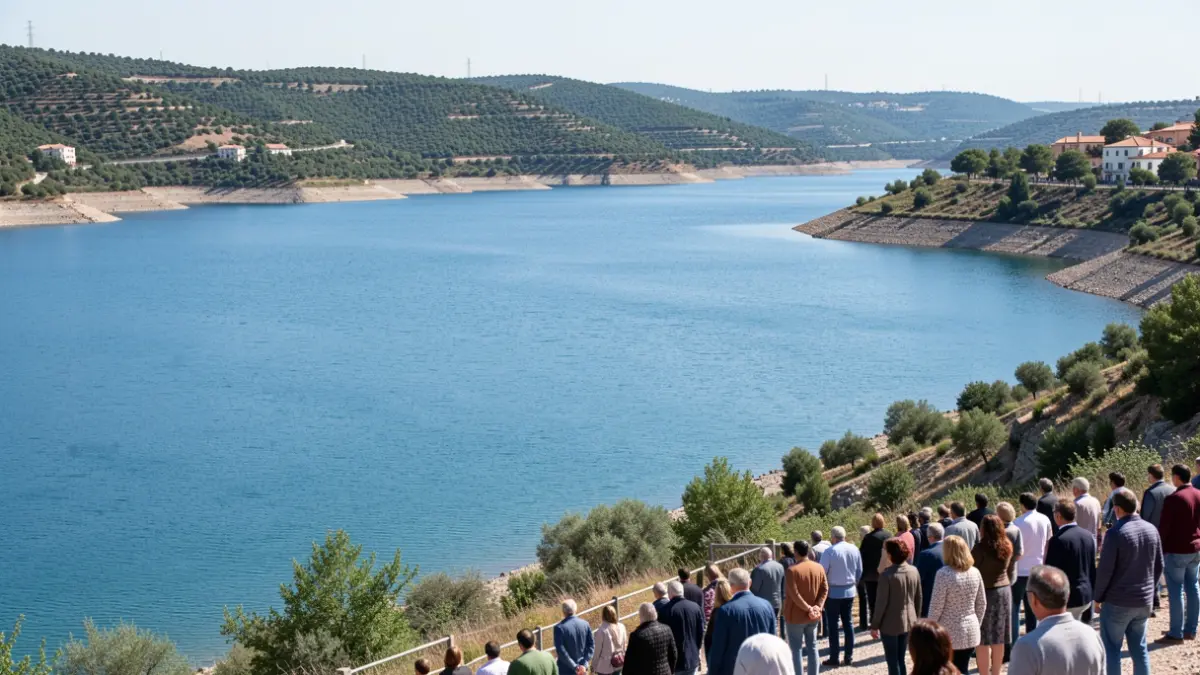
The Minister of Environment, Agriculture, and Interior, Carlos Novillo, has issued a warning regarding the inherent dangers of swimming in undesignated areas of the San Juan Reservoir, located in the southwest of the Community of Madrid. These statements follow a tragic incident that occurred the previous weekend.
Novillo voiced his concern about the possibility of such incidents recurring annually, despite awareness campaigns promoted by the regional Executive. "That the information does not reach all citizens is perhaps what worries us the most," the minister admitted.
The head of Environment emphasized that the prohibited zones are not open waters but "very dangerous" locations characterized by steep drops, considerable depths, reduced visibility, and bottoms with obstacles like mud or debris, where swimmers can become trapped.
He further cautioned that factors such as alcohol consumption or prolonged sun exposure significantly increase the risk when swimming in unauthorized places. "We have another tragedy," he summarized with regret.
The Community of Madrid deploys a safety operation each summer in the two designated swimming areas at the San Juan Reservoir: Virgen de la Nueva beach in San Martín de Valdeiglesias, and El Muro beach in Pelayos de la Presa. Personnel from SUMMA 112 and the Red Cross operate in these zones, supported by lifeguards during the summer season.
Novillo noted that these professionals conduct up to 200 interventions annually, highlighting that they "save lives and there is no problem when they are there."
Outside these designated areas, swimming is prohibited for reasons of safety, water quality, and environmental protection. The minister specified that neither the Tajo Hydrographic Confederation nor the Isabel II Canal authorize swimming at these points.
The minister acknowledged the Community of Madrid's limited capacity to control access to the reservoir's surroundings, given its vast expanse, the multitude of entry points, and the presence of developments with direct access or private jetties.
"We cannot monitor all the kilometers and kilometers of reservoir shores," stated Novillo, adding that local municipalities are requesting intensified surveillance.
The regional official defended the information campaigns run by the Madrid 112 Security and Emergency Agency, the Forest Rangers, and the Red Cross, but insisted that public awareness is crucial for preventing risky behavior.
Novillo likened the situation to driving under the influence of alcohol or at high speed: "When you drive at 200 kilometers per hour or drive drunk, you know you are risking your life. So, obviously, do not swim in a place that is prohibited, unmonitored, and where you have also consumed alcohol," he concluded.
The Community of Madrid currently authorizes five natural swimming areas throughout the region and has enhanced surveillance this summer in protected spaces, particularly in La Pedriza and the upper course of the Manzanares River, where swimming is forbidden.