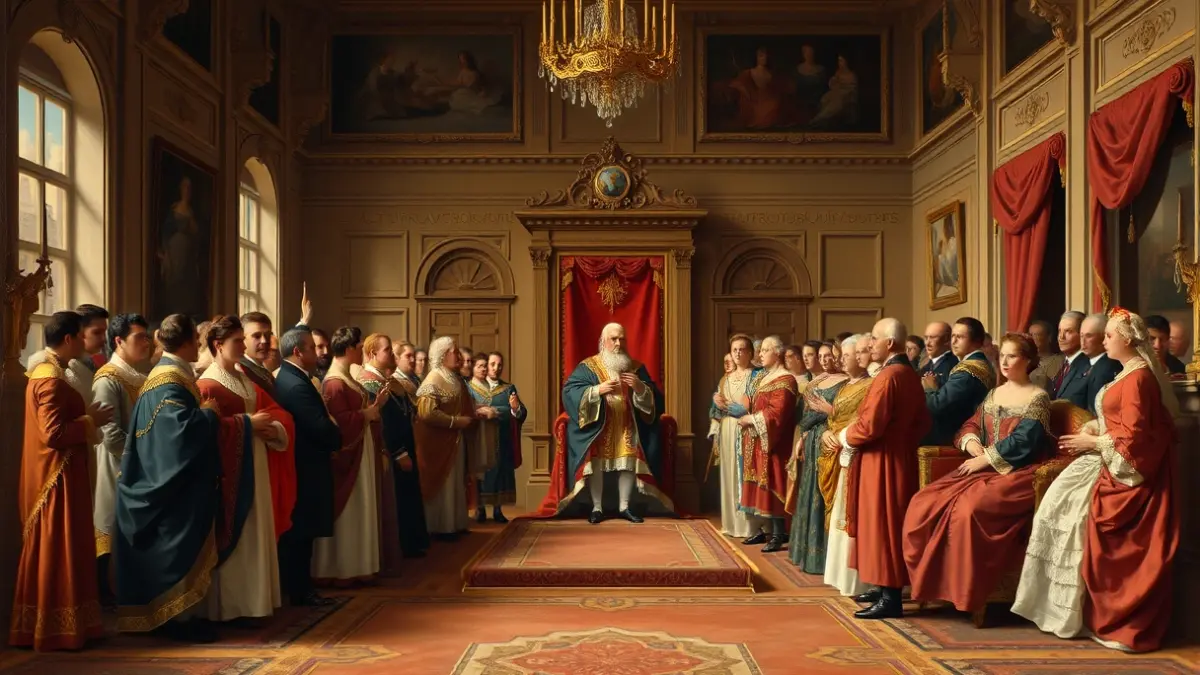
The oath ceremony of Carlos IV, held in Madrid, was characterized by strict protocol, including the swearing of the fueros and the presence of the kingdom's grandees. Everything was designed to convey the idea that the change of monarch would not imply an alteration of the established system, an objective that, on the surface, was achieved.
However, the new monarch, despite being well-acquainted with the court's workings, showed a clear tendency to delegate more complex matters. His governing style was marked by brief audiences and quick resolutions, avoiding the strain involved in difficult decisions. This attitude was not due to a lack of discipline, but a conscious choice of where to apply his energy.
He was not a king who sought to impose himself. He did not have that inclination. In practice, this translated into brief audiences, seemingly quick resolutions, and a constant tendency to shift the most complex matters to others.
This behavior fostered the rise of figures like Manuel Godoy, who filled the power vacuum by taking responsibility for turning conversations into decisions and managing their consequences. Concurrently, Queen María Luisa of Parma also played an active role, intervening and influencing court dynamics. The result was a system with multiple decision-making centers, leading to friction and a loss of precision in the execution of orders.
The perception in Madrid was not one of open crisis, but of an authority that, though present, failed to fully assert itself. Even in art, such as Francisco de Goya's portraits of the royal family, this new reality is reflected, showing the monarchs without the traditional heroic idealization. This power shift became more evident with the onset of the French Revolution in 1789, which transformed governance from a task of preservation to one of constant crisis response, a scenario for which Carlos IV's model was unprepared.


