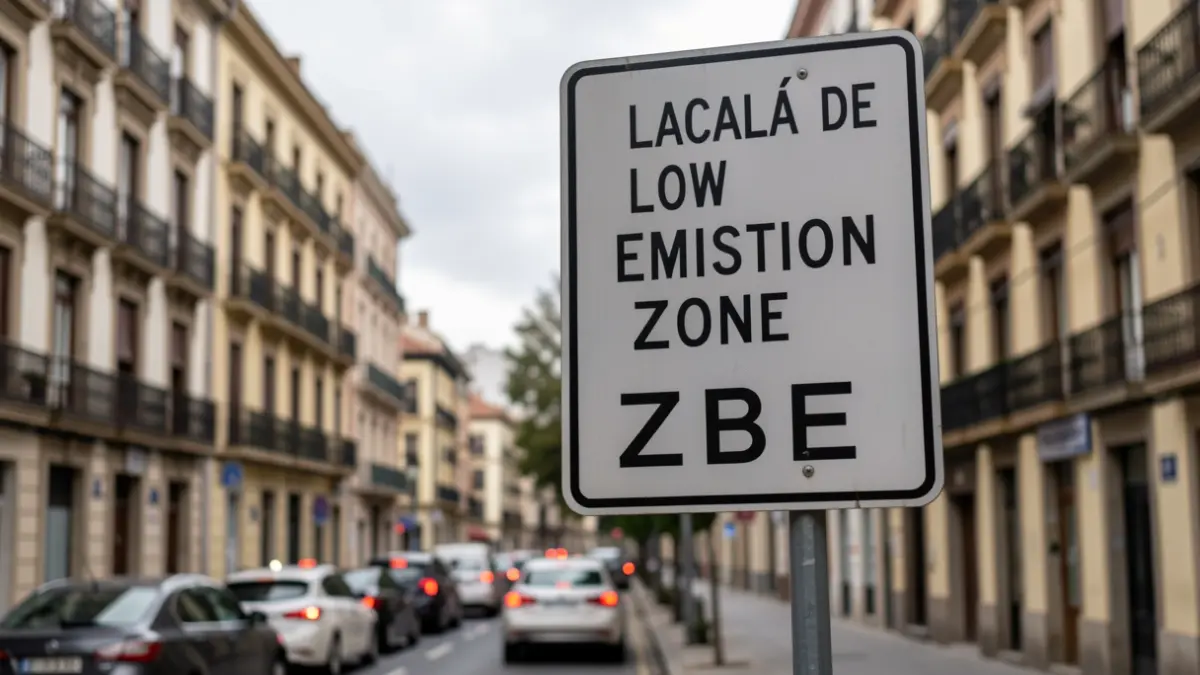
Despite having regulations, signage, and an administrative structure, the Low Emission Zone (LEZ) in Alcalá de Henares has not translated into tangible changes for most of its drivers. Traffic within the urban center maintains a similar appearance to previous months, with vehicles of various environmental labels moving without apparent restrictions.
This situation has generated confusion among residents and regular users of the city center, especially those who invested in hybrid or ECO vehicles. The expected difference in mobility or parking, at least for now, is minimal. Unlike other Spanish cities where LEZs have involved visible limitations or clear incentives, the implementation in Alcalá seems to be progressing at a different pace.
Municipal regulations contemplate progressive restrictions linked to pollution levels, particularly nitrogen dioxide, but these would only be activated during specific high-pollution episodes. Under normal environmental conditions, traffic remains practically habitual, even for more polluting vehicles. This conditional nature fuels the uncertainty and doubt among drivers about when and how restrictions will actually be applied.
Confusion is notable regarding ECO-labeled vehicles, whose users do not perceive clear differences in parking rates or conditions. While the ORA (regulated parking) system does offer benefits for ZERO-emission vehicles and people with reduced mobility, the advantages for ECO vehicles are less evident. In contrast, the expansion of regulated parking zones is indeed perceived by many residents, with more streets subject to hourly control and a greater sense of enforcement.
Public perception oscillates between an approved regulatory framework aligned with European requirements and a reality on the asphalt where substantial differences from previous years are scarce. This leads to the ironic question often arising in informal conversations: 'Is the LEZ already working or not yet?' In Alcalá de Henares, the LEZ presents itself as an administrative reality: officially implemented, politically supported, but still difficult for a large part of the citizenry to perceive.