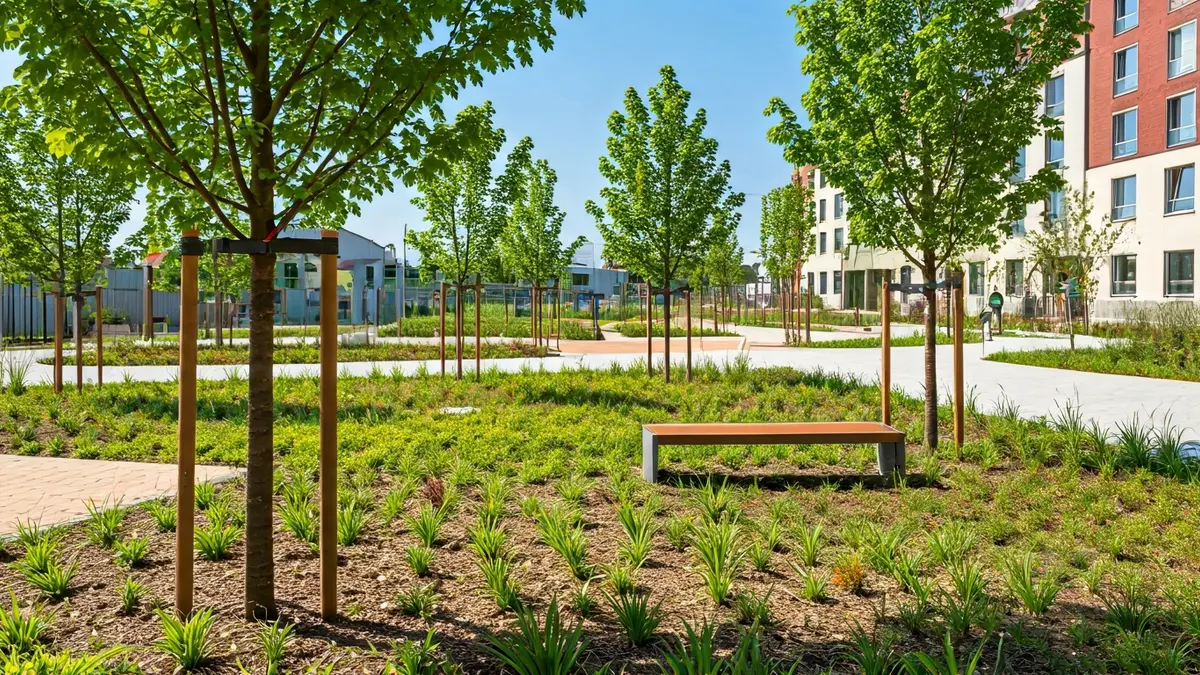
The works, covering an area of 8,600 square meters, have converted these school environments into resting and meeting areas, with a design that prioritizes the safety of students and their families. The intervention included the removal of pavement to recover natural soil and the creation of new green zones.
At the CEIP Mario Benedetti and CEIPSO La Luna centers, renaturalization has allowed for the creation of green areas intended for the educational community to gather. Additionally, the installation of new children's play equipment is planned for these spaces. At CEIP Rafael Alberti, the action has integrated and improved the area next to San Sebastián Street, adapting it to the surroundings.
The renaturalization project has incorporated the planting of 139 trees of 15 different species, along with 1,970 shrubs and a natural meadow spanning 290 square meters. Among the plant species are poplars, oaks, and broom. These species are signposted with informative panels and QR codes, offering an educational resource complemented by the Cuaderno de Barrio (Neighborhood Notebook) from the Rivas City Council.
Furthermore, new urban furniture has been installed, including waste bins, benches, and drinking water points in the resting areas. These actions are part of the Renatura Rivas project, focused on the renaturalization of the West neighborhood and the creation of an ecological corridor.
The initiative is supported by the Biodiversity Foundation of the Ministry for Ecological Transition and Demographic Challenge, and is funded by European Next Generation funds through the Recovery, Transformation and Resilience Plan. The educational community has actively participated with 25 workshops and activities, such as waste cleanup, native species nursery cultivation, and environmental awareness campaigns.