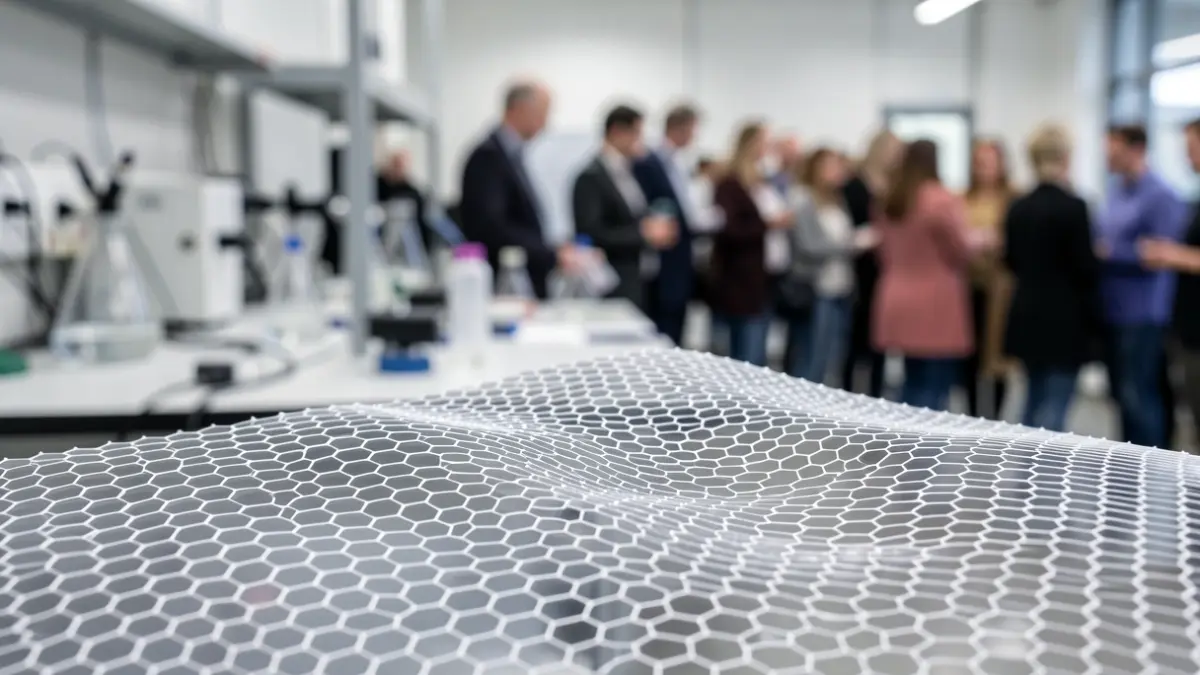
Research in quantum physics and the development of advanced materials have led to a fascinating discovery: rotating atomic-thickness graphene sheets with a minimal twist generates a 'magic angle' that allows for the creation of materials with extraordinary properties. This breakthrough, spearheaded by scientists like Pablo Jarillo-Herrero, is revolutionizing the field of twistronics.
Graphene, composed of a single layer of carbon atoms in a hexagonal pattern, is a 2D material known for its strength and lightness. The discovery that a slight displacement between graphene layers, just over one degree, creates a Moiré pattern and substantially alters electron behavior, leading to unexpected properties, was first published in Nature in 2009.
The mathematical theory developed by Allan McDonald determined that this 'magic angle' (approximately 1.1 degrees) is crucial. At this twist, the material can become superconducting, and with different angles, it could exhibit insulating or magnetic properties. This finding, published in PNAS in 2011, took years to be experimentally validated due to the difficulty of fabricating the decoupled layers.
The term 'twistronics' was coined in 2016 to describe electronics based on material rotation. The definitive boost came in 2018 when Pablo Jarillo-Herrero and his team at MIT demonstrated in two simultaneous papers in Nature their ability to fabricate multilayer graphene with varying rotation conditions, achieving superconducting or insulating materials depending on the twist angle. This discovery went viral within the physics and materials science communities.
Jarillo-Herrero has described twistronics as an 'anti-philosopher's stone,' as it allows a single material, graphene, to behave like many others simply by altering its configuration. This approach, similar to metamaterials, has spurred research into three-layer structures, multilayers, and three-dimensional materials.
The phenomenon is now being studied in other materials such as transition metal dichalcogenides (TMDs) for optoelectronics, hexagonal boron nitride (h-BN) for ultra-thin memories, and complex perovskite structure oxides for quantum computing. These materials are prioritized by the European Union for its technological transitions.
The primary challenge today is the industrial scaling of these technologies, which will take years. However, the emergence of Artificial Intelligence in this field could accelerate the application of these advancements into our daily lives, covering areas such as quantum computing, low-power electronics, and high-precision magnetic sensors.