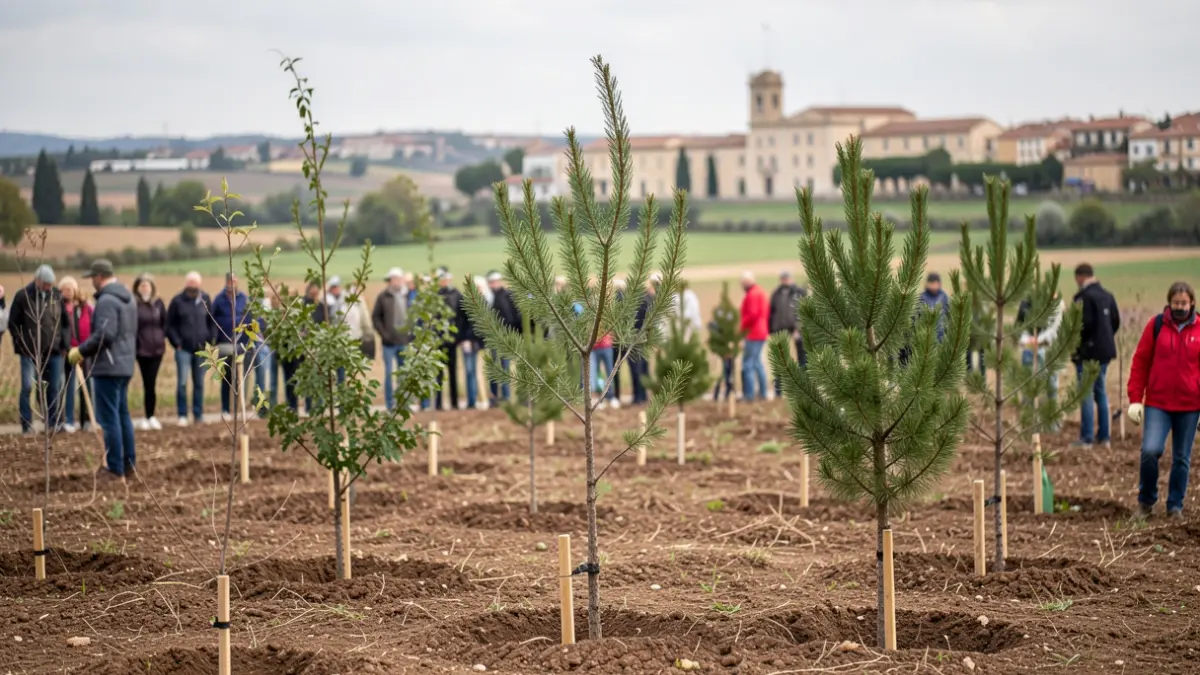
AURO workers have planted 100 holm oaks, 50 Pyrenean oaks, 50 kermes oaks, 30 Spanish broom, and 20 stone pines on a municipal plot exceeding 16,775 square meters located in the Verde del Tajuña, near the old paper mill and parallel to the Cuesta de Chinchón path.
The event was attended by the mayor, Yolanda Cuenca, and several council members from the Governing Team. This action is part of a broader reforestation project promoted by the City Council's Department of Environment, following its adherence to an agreement between the Madrilenian Institute for Rural, Agrarian, and Food Research and Development (IMIDRA) and the Federation of Municipalities of Madrid, aimed at promoting the planting of native species in the region's municipalities.
The municipal adhesion, approved in March of the previous year, has enabled the start of planning work to restore various degraded municipal natural spaces. For this, the Consistory has received technical advice from IMIDRA, whose professionals studied the land and the most suitable plant species to ensure restoration respectful of the environment's characteristics.
The City Council has made this municipal plot available to the Reforest Project Foundation, which aims to bring together companies committed to sustainability, like AURO, with city councils willing to restore natural spaces, contributing to improved biodiversity, landscape regeneration, and the preservation of environmental heritage for future generations.
The work, which will continue over the coming days to reach the planting of 600 specimens, is being carried out manually and includes the installation of protectors against rabbits and is based on an irrigation program to promote the rooting and survival of the new specimens, especially during the summer months.