The National High Court has issued a ruling compelling ADIF, the Railway Infrastructure Administration, to undertake the necessary conservation and maintenance actions for the elevated passage on Antonio Varela street in Collado Villalba. The objective is to prevent both personal and material damages stemming from the structure's condition.
The works required by the court encompass key bridge elements such as the reinforcement bars, deck, beams, and abutments, aiming to enhance the overall safety of this railway infrastructure. These actions are part of a report submitted by ADIF to the judiciary in early 2025, following precautionary measures ordered on January 8, 2025, by the Central Court of Administrative Litigation No. 5 of Madrid. These measures mandated the City Council to take steps to ensure the elevated passage's safety, leading to its closure to traffic on January 9 and subsequent reopening after the report's submission.
The sentence, delivered by the Contentious-Administrative Chamber of the National High Court, dismisses the appeal filed by ADIF against a previous order dated January 7, 2025. Although a further appeal to the Supreme Court is still possible, the current judicial decision reiterates ADIF's responsibility for carrying out the maintenance works.
While the bridge's ownership is yet to be judicially determined, ADIF will have to bear the costs of these works while the matter is resolved. This marks the third judicial decision in favor of the Collado Villalba City Council, which has consistently urged ADIF to guarantee the safety of an infrastructure it considers within its purview. The council seeks the prompt execution of the works.
The Councilor for Urban Planning stated that the ruling classifies the bridge as part of a railway infrastructure of general interest. A municipal legal report had already indicated this, referencing the Railway Sector Law 38/2015, which assigns responsibility to the Administrator of Infrastructure (ADIF) for the operation, maintenance, and renewal of the network.
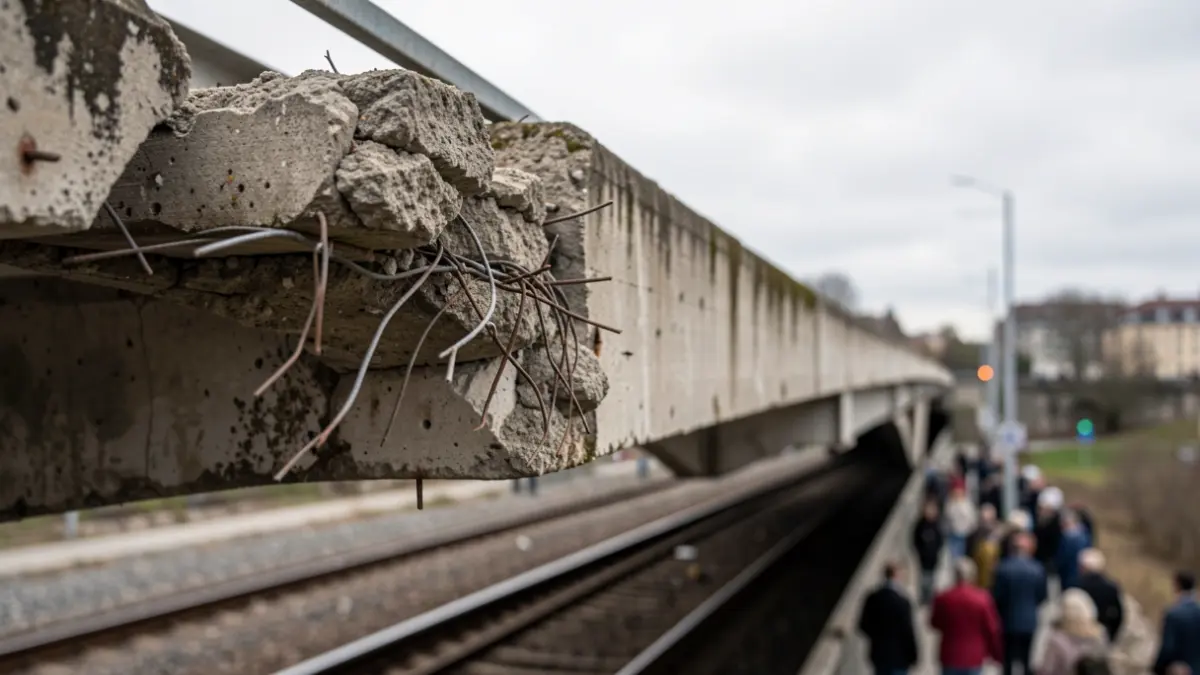
The defects identified by the municipal technical services include the loss of the compression layer and partial cover of the reinforcement bars in parts of the deck and beams, as well as corrosion and section loss in some elements. The concrete in the abutments is showing signs of detachment due to 'depassivation,' which exposes and oxidizes the steel bars, reducing their load-bearing capacity and causing fragments to fall.