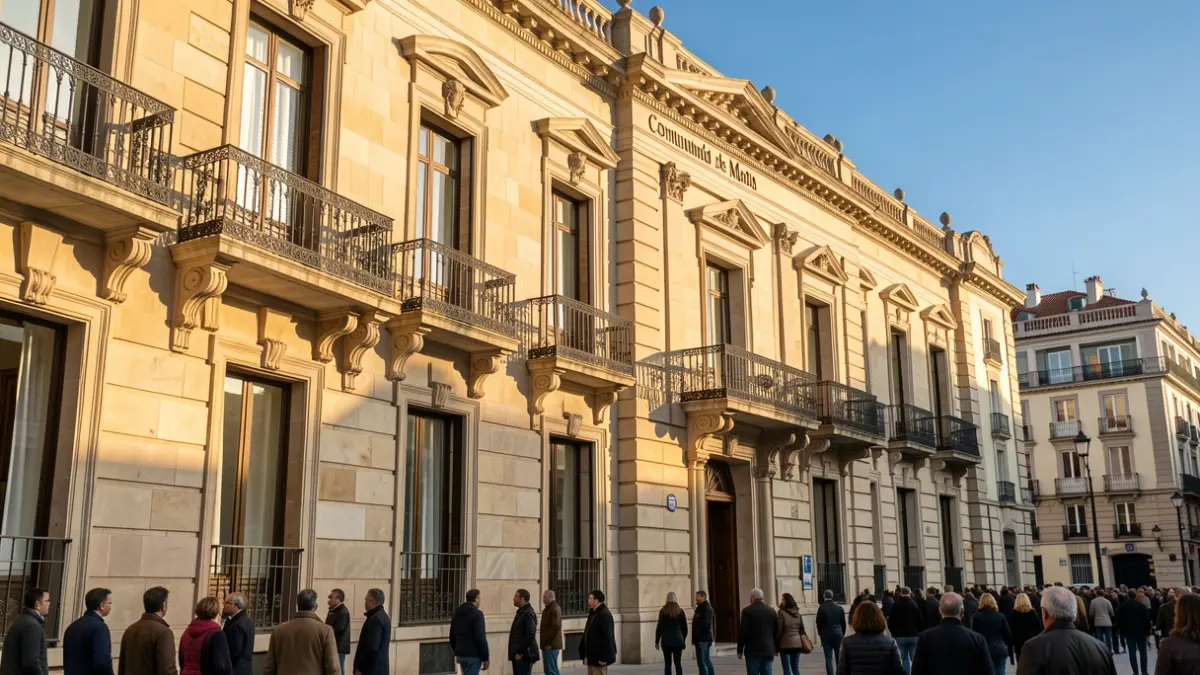
The Infante Don Luis Palace in Boadilla del Monte was the venue this Tuesday for a conference dedicated to examining the main challenges of urban waste management in the Community of Madrid. The event, titled 'Urban Waste Management in the Community of Madrid: Challenges, Costs, and Future Model', brought together institutional representatives, municipal officials, industry companies, and specialists to debate the system's evolution and the need for adaptation to new environmental requirements.
The session addressed issues related to the territorial organization of services, the costs associated with waste treatment, and future prospects in a context marked by the advancement of the circular economy and the tightening of European and national regulations.
The conference began with an address by Madridiario director, Juan Pajares, who emphasized the need to analyze the sector's current situation, strengthen collaboration between administrations and companies, and make the meeting a useful forum for extracting applicable proposals for daily waste management.
The official inauguration was carried out by the Vice-Minister of Presidency and Local Administration of the Community of Madrid, who explained that regional policy is based on 'accompanying' the 179 Madrid municipalities and their associations through funding, technical advice, and tools that allow each town hall to develop solutions adapted to their circumstances, favoring flexibility over uniform models.
The Vice-Minister particularly criticized the impact of the new state waste tax, stating that many mayors have had to justify cost increases to their residents stemming from regulations approved without necessary funding. He considered it inappropriate to transfer all economic and administrative pressure to municipalities without consulting those who manage services on the ground or the specific reality of each locality.
He also argued that environmental protection and economic growth are "two sides of the same reality" and should not be used to increase the burden on citizens. He highlighted the Madrid Circular Economy law and recalled that the regional government has mobilized over 400 million euros to promote waste reduction, recycling, and reuse. The Community of Madrid's commitment to a model based on "incentive, not imposition" was reaffirmed, aiming to reduce bureaucracy and provide legal certainty.
The first debate panel, moderated by Víctor Sarabia, Director General of Cleaning and Waste Services for the City Council of the capital, brought together representatives from Fuenlabrada, Madrid, Leganés, Pinto, and Alcorcón. Despite different territorial realities, they all agreed that "the first link in waste management policy is the citizen" and defended the need for improved funding, strengthened institutional collaboration, and progress towards a more efficient circular economy.
Ricardo Luis Izquierdo, Director General of Circular Economy for Fuenlabrada, warned that "waste management is a problem and it's growing" and admitted that "we have managed waste poorly for years," relying excessively on landfilling as the cheaper alternative. He defended the economic potential of the circular economy, recalling that "every time we throw away a piece of plastic, we are throwing away oil that we don't have and have to buy from abroad."
María José Delgado, Director General of the Valdemingómez Technology Park, highlighted that Madrid has already exceeded the selective collection targets set for 2030, but cautioned that "what is not separated correctly at home is much more difficult and costly to recover later at the plants." Delgado advocates for energy recovery to reduce landfill use and produce electricity, and extended a hand to the private sector: "We need collaboration."
Violeta Bonet, Councilor for the Environment of Leganés, insisted that "prevention cannot remain a slogan; it must become a habit" and called for greater coordination between administrations to face regulatory changes and future waste treatment projects.
The mayor of Pinto, Salomón Aguado, argued for redistributing treatment infrastructure, recalling that his municipality has hosted a landfill receiving waste from dozens of localities for four decades. "A landfill designed to last seven years has been operating for forty," he lamented, concluding that "continuing to expand landfills is continuing to do it wrong."
Santiago Anes, General Coordinator of Citizen Services for Alcorcón, considers it necessary to raise citizen awareness about the real cost of the service because "we have become accustomed to waste disappearing without asking what happens to it afterward." He called for greater regional commitment to promote a "territorial rebalancing" of the necessary facilities for waste management.
Subsequently, attention turned to the role of specialized companies and the economic viability of the current model. The discussion was moderated by David J. Mesa, deputy mayor and delegate councilor for the Environment of the Boadilla del Monte City Council.
Sergio Cabellos, Director of Public Business at PreZero España, stressed that structural changes are slow and require a combination of taxation, planning, and awareness, stating, "I haven't seen any country truly change the model we have today in less than 12 or 15 years." He added that the problem isn't money, "there is funding and private investment capacity. The real debate is social and economic: how much does it cost to improve the system, and how do we explain to the citizen that doing so will have a higher cost than the current model." He also argued that "energy recovery must coexist with recycling. We cannot overstate it."
On the technological front, Juan Carriedo, Director of Services at SULO Ibérica, highlighted the need to "turn waste into a utility." He emphasized the importance of user identification systems as a tool for efficiency and fairness: "When the citizen is identified, they do better. Furthermore, the fee is fairer."
In line with this, Eduardo Fernández, Director of Innovation at Urbaser, insisted that technology should support, not replace, labor: "Technology must help the worker, not implant a robot to replace them," and stressed that investment should be understood strategically: "We should not interpret it as an expense, but as an investment."
From the perspective of citizen involvement, Antonio Rodríguez, director of the Madrid delegation of FCC Medio Ambiente, pointed out that the key lies in effective awareness: "People need to see that all the work they do at home serves a purpose," advocating for bringing treatment plants closer to the population to reinforce understanding of the system.
Finally, José Luis Salegui, Director of Urban Services and Waste Treatment for Madrid at Valoriza Servicios Medioambientales, focused his intervention on the role of education and investment to meet European objectives, recalling the importance of source separation and its impact on subsequent treatment, with higher recovery rates. "Not doing so is more expensive."
The event concluded with addresses from the general secretary of the Madrid Federation of Municipalities, José Manuel Zarzoso, and the mayor of Boadilla del Monte, Javier Úbeda, who agreed in demanding greater support, flexibility, and resources for municipalities from higher administrations. Both criticized the central government's approach to waste management regulation, especially the implementation of the municipal tax, considering that local perspectives were not taken into account.
Zarzoso clearly defended European environmental objectives. "We want to recycle more and better and move towards a circular and sustainable economy," he remarked, while demanding that these advances be accompanied by real support for town halls with "more flexibility and resources." In this vein, he rejected new tax burdens on residents, "such as the Spanish Government's waste tax," and advocated for a model based on collaboration and citizen participation: "Sustainability cannot be built through taxes, but with public-private collaboration, investment, and awareness."
For his part, Úbeda insisted that waste management must be addressed from a municipalist perspective and through coordination: "It is an issue that affects us all" and must be done "by listening to the town halls." He criticized the waste tax, considering that it "does not reduce the waste we generate, does not increase recycling, nor does it provide new solutions," but rather responds to an "ideological" logic that "forces town halls to be fiscally more aggressive." In his final address, he argued that "waste management requires stability, coordination, and shared strategy," against what he described as "misunderstood environmentalism" that can lead to "paralysis."
The conference, organized by Madridiario and promoted by the Boadilla del Monte City Council, could be followed live via streaming and on social media using the hashtag #GestiónResiduosMDO. The event was also sponsored by FCC, PreZero, Urbaser, and Valoriza, with the collaboration of SULO and Diariocrítico.