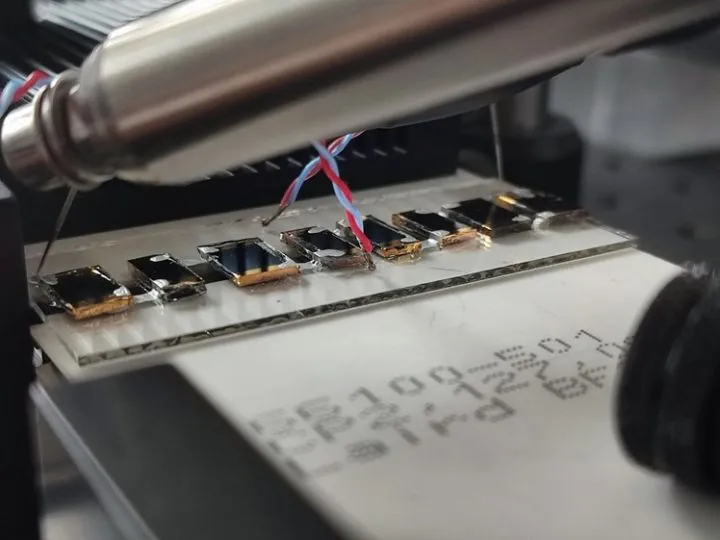
This breakthrough, published in the journal Materials Today Energy, allows for the utilization of small temperature differences to generate electricity, with silver selenide achieving one of the highest recorded efficiencies to date at room temperature.
Thermoelectric materials, which operate via the Seebeck effect, are of great interest for recovering waste heat in various processes and devices, such as industrial heat recovery and the development of small autonomous devices.
The developed methodology stands out for its simplicity, economy, and for being carried out at room temperature, without the need for vacuum chambers or high-temperature treatments. Electrodeposition allows for control over the material's composition, crystalline structure, and morphology, facilitating more scalable manufacturing.
The results obtained are remarkable: silver selenide exhibits a power factor that places it among the highest performing n-type thermoelectric materials at room temperature, while for copper selenide, the results quintuple previous marks achieved by electrodeposition.
The study has also validated the reproducibility and stability of the method, with minimal variations in material properties after eight months and 40 thermal cycling variations.
Potential future applications include compact thermoelectric generators for autonomous sensors, the Internet of Things (IoT), energy recovery from waste heat in industrial processes, and integration into portable electronic devices and “wearable” technologies.