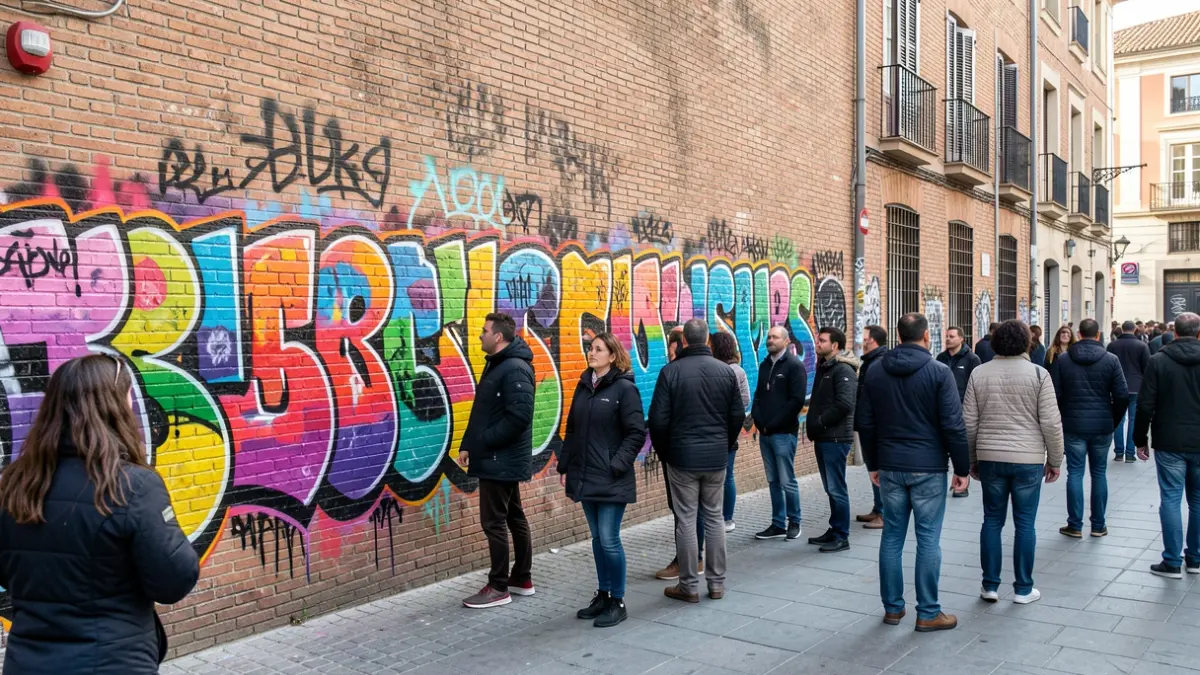
The exhibition reconstructs the early years of hip hop culture in the capital, when a new generation began to incorporate new forms of expression and transform the city through graffiti, rap, DJs, and breakdancing.
In a city undergoing profound political, social, and cultural transformations, new signatures and ways of visually occupying public space emerged, while dance, music, and spoken word opened up new avenues of expression for a youth seeking new references.
Hip hop thus arrived in Madrid and, far from merely reproducing models from the United States, was appropriated, reinterpreted, and transformed by its protagonists, giving rise to a scene with its own personality.
The exhibition is based on extensive research and brings together historical photographs and documents, audiovisual material, publications, recordings, and collector's items. Through these materials and, especially, the testimony of those who lived through those years, the exhibition reconstructs how graffiti, rap, DJing, and breakdancing arrived in Madrid, how they began to relate to each other, and how they quickly spread throughout various neighborhoods and municipalities of the Community.
It presents hip hop as a collective cultural phenomenon, born from youth creativity, experimentation, and the need to express oneself and be visible. The exhibition explains how this culture originated, what city made it possible, and how its various disciplines built a common identity.
'Madrid Hip Hop. Origins' traces a culture linked to the street, independent creation, and spaces far from conventional cultural circuits, whose legacy remains fully valid and is already part of the cultural and visual history of Madrid.