
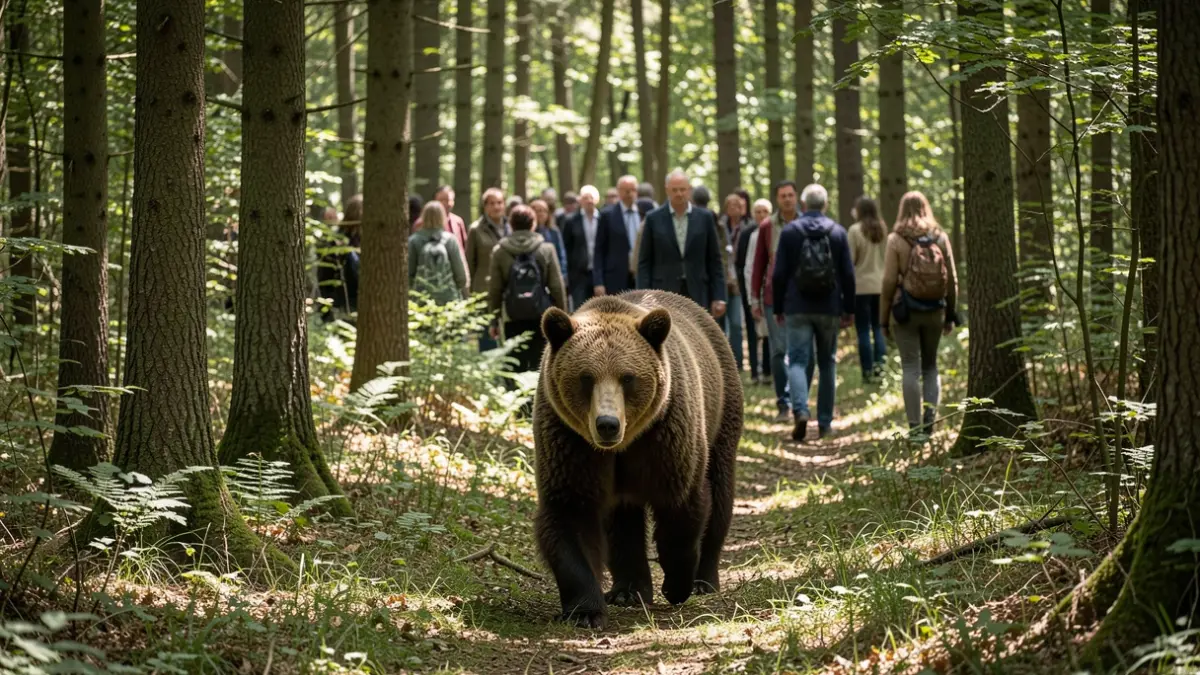
The study, published in the journal Global Ecology and Conservation and conducted in collaboration with the University of Exeter and the Junta de Castilla y León, highlights that the behavior of large carnivores varies significantly according to topography and bear population density in their habitat. These findings are crucial for the conservation and adaptive management of the brown bear in environments shared with humans.
In the eastern subpopulation, with lower bear density, males cover greater distances, especially during the mating season, to find females. These bears markedly avoid roads and crops, showing more caution towards people, and prefer forests with moderate canopy and non-forested areas.
Conversely, in the western subpopulation, with higher densities of both bears and humans, bears prefer denser forests and appear to tolerate humanized areas better. This tolerance could be an adaptation to high competition, leading them to occupy suboptimal habitats and use valley floors and areas near villages at night to reduce encounters with people.
The authors emphasize that the bear's response to human presence is not uniform, varying between populations and subpopulations, which demonstrates a remarkable capacity for adaptation. Conflict management is an immediate priority in the western subpopulation, while in the eastern one, proactive anticipation is recommended due to the potential approach of bears to humanized zones.
The researchers highlight the value of sustained collaboration between public administration and public universities in developing effective scientific tools for the management and coexistence of threatened species in humanized landscapes. The Junta de Castilla y León will use these results to further optimize its preventive and management measures in the Cantabrian Mountains.