
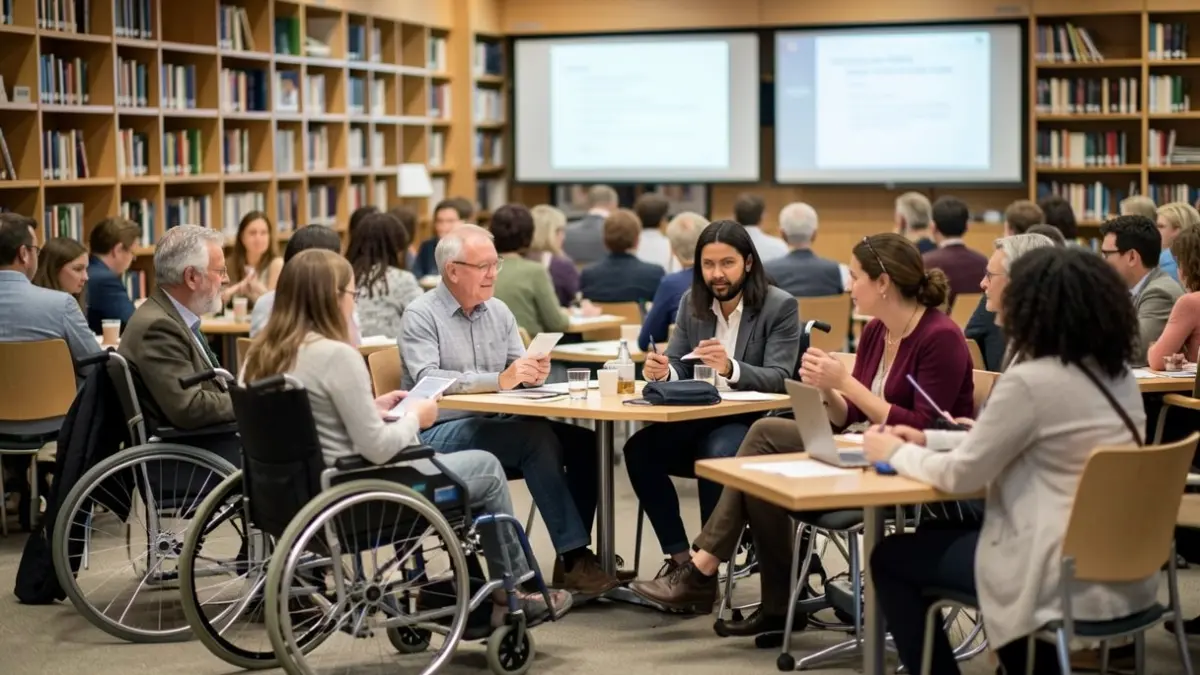
The congress, organized by the Department of Applied Communication Sciences and co-directed by Khadija Ftah and Jorge Rodríguez-Moreno, defines itself as a space "from disability, not about it," with an organizing and scientific committee largely composed of people with disabilities. During the opening, authorities such as Agustina Borrás López, president of ASPACE Madrid, and Jesús Martín Blanco, Director General of Rights of Persons with Disabilities, emphasized the importance of creating an inclusive and supportive academic environment.
The ACADIS project, led by Carmen Márquez Vázquez and Laura Sanmiquel Molinero, highlighted the lack of data on how many women with disabilities academic institutions employ, hindering their progression. Cases were reported of careers sustained with personal funds and sick leave due to adverse academic situations. "Inclusion is about being there, but also about progressing," stated Márquez, who also stressed that questioning "academic ableism" benefits everyone.
Figures presented indicate that people with disabilities represent only 1.09% of the teaching and research staff in Spanish universities, and 68% of institutions lack specific regulations for reserving positions. José Antonio Rueda Monroy, a Labor Law professor, lamented that despite reserved places in programs like Juan de la Cierva or Ramón y Cajal being filled, there are still students with high disabilities who cannot access basic support due to budget constraints.
Sociologist Sophie Savage delivered the keynote lecture "Situated Epistemologies: Researching from Disability," sharing her personal experience as a subject of study and advocating for co-production methodologies, involving people with disabilities in all research phases. "Co-design is essential; without it, it makes no sense," she stated, praising the CIDID model as the "gold standard" for future congresses.
During the panel "Identity, Transformation, and Social and Academic Activism from Disability," speakers such as Melania Moscoso (Institute of Philosophy, CSIC) rejected "symbolic inclusion," declaring: "We don't want to be normal, we don't want to be included, we want to be researchers." Juan Pablo Salazar, Director of Inclusion at CAF, summarized that the congress's existence is "an indicator in itself that something is wrong in academia."
In the panel on AI, virtual reality, and the metaverse, David Sabaté, CEO of Tothom, warned that AI by default generates inaccessible pages by learning from predominantly inaccessible content, regressing web accessibility. Emiliano Díez Villoria, director of INICO, recalled the low implementation of "design for all" in engineering degrees.
The congress also included four practical workshops. One, "Conceptualizing Disability," proposed studying ableism as a system of power. Another addressed scientific dissemination through easy-to-read formats supported by AI and validated by people with cognitive disabilities. Keys were offered for public speaking and controlling one's narrative in the media, and a "Survival Manual in Academia" provided legal tools to demand reasonable adjustments and support.
At the closing, the congress connected with Colombia, where María Isabel Pinzón Ochoa noted that only 17% of people with disabilities access higher education. Rossana Cuervo Botero highlighted the lack of evidence in many actions taken. The congress, held in a hybrid format with 440 attendees and 141 communications presented from about twenty countries, committed to continuing and being replicated internationally.