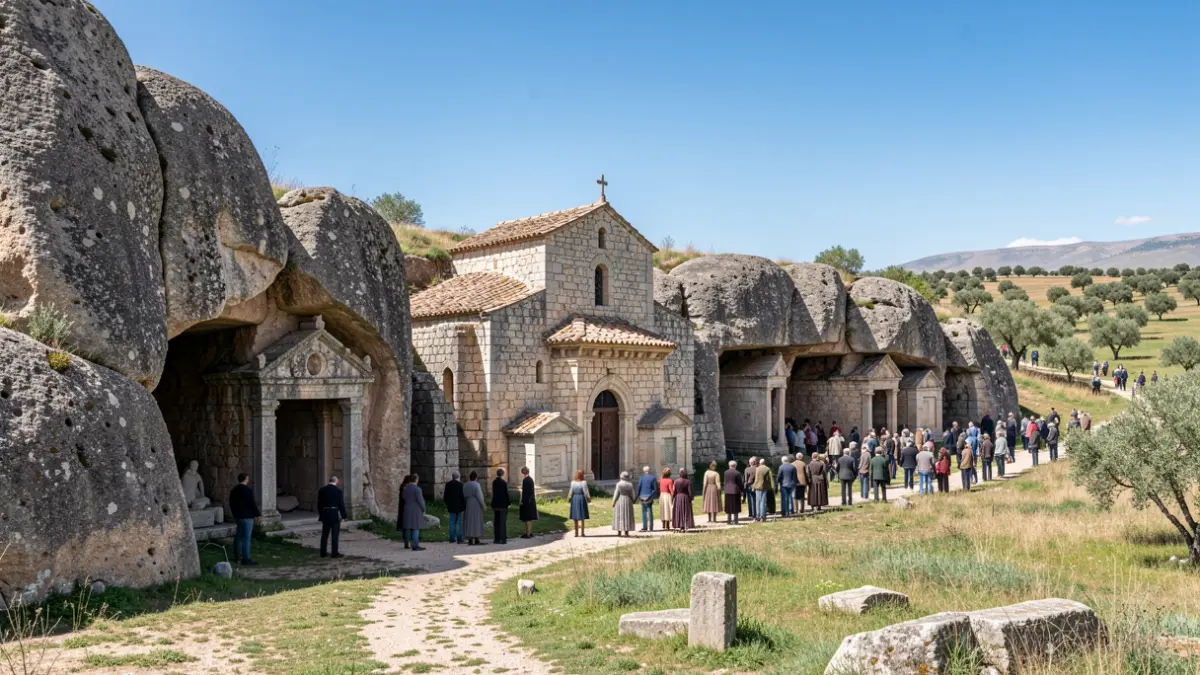
The Governing Council of the Community of Madrid this week declared the medieval necropolis of Sieteiglesias, located in the urban area of the town belonging to the Sierra Norte de Madrid, an Asset of Cultural Interest (BIC), categorized as an Archaeological Zone.
Dated between the 9th and 11th centuries, the necropolis consists of 85 tombs situated around and beneath the church of San Pedro Apóstol. Research into this site, of great archaeological value and surrounded by dehesas, meadows, and trees, began at the start of this century, with a first excavation in 2001.
Subsequently, restoration, consolidation, and conditioning work was carried out on the site to ensure its accessibility and musealization, with the aim of including it in the Plan of Visitable Archaeological Sites of the Community of Madrid.
The burials are distributed in three zones to the north, east, and southeast of the church. Two types of tombs are distinguished: simple pits dug into the rock and usually grouped, closed with a stone slab; and cist tombs, formed by several slabs placed vertically in the ground like a box and covered by another used as a lid.
Different periods of use are evident: a first phase from the 9th to the 11th centuries, which some studies suggest may have been active until the 15th century, and a second stage in the 17th century when earlier tombs were repurposed, showing signs of reuse and containing human remains.
The archaeological materials found include coins, medals, ceramic pieces, glazed pottery, porcelain, and Talavera-type ceramics.