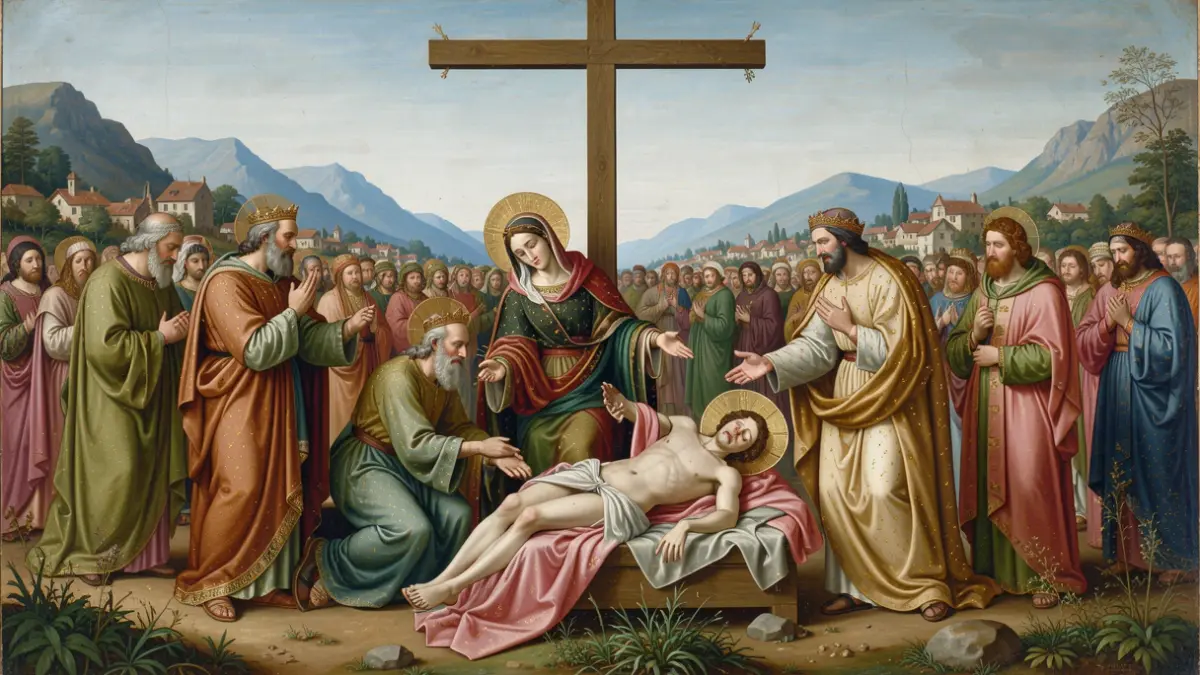
The work, an oil on panel dated to the 16th century (likely between 1507 and 1508), was created by Paolo de San Leocadio, one of the great masters of the Italian Renaissance who brought this style to Spain in 1472. The painting was produced during his final productive period in the Duchy of Gandía, under the patronage of the regent duchess María Enríquez de Luna.
The panel depicts the moment after Christ's descent. In it, the Virgin Mary holds Jesus' body and takes his right hand, showing the nail wound. Saint John and other companions are positioned on either side of the empty cross, which acts as the scene's central axis. The lower edge of the work features a strip of wild vegetation among small rocks. In the background, two groups of figures and a village surrounded by mountains can be distinguished.
The painting is notable for its fine lines and small golden dots that add glints to the robes, headdresses, and halos. The ochres, greens, and pinks in the foreground areas contrast with the blues of the distance, where the use of sfumato softens the landscape's contours and gives the sky a hazy appearance.