Let's imagine an absurd scene for a moment. A family arrives at the hospital with their son. They greet the doctor, give him the boy's name, and leave for the waiting room without telling him anything else. The doctor, who is excellent and has all the machines in the world at his disposal, is left alone with a name. Where does he start? An X-ray? A blood test? An MRI, at random?
The scene makes no sense. And yet it describes, more often than we think, what happens in many classrooms on the first day of school.
A school has almost everything. Prepared teaching staff, training, resources, technology. Just as a hospital is prepared to save lives, an educational center is prepared for the success of its students. But there is a small, almost invisible piece, without which everything takes more effort and more time. It's not the teachers. It's not the resources. It's the essential information about each student. Knowing who they are, how they learn, what they struggle with, and what they excel at.
A good doctor doesn't need the family to give him a diagnosis. He needs the reason for the consultation. That information that only the family has and that changes everything. It's exactly the same with a teacher. We don't ask them to diagnose or label anyone. We give them something more useful. An organized overview of each student to be able to support them from day one.
What the data says
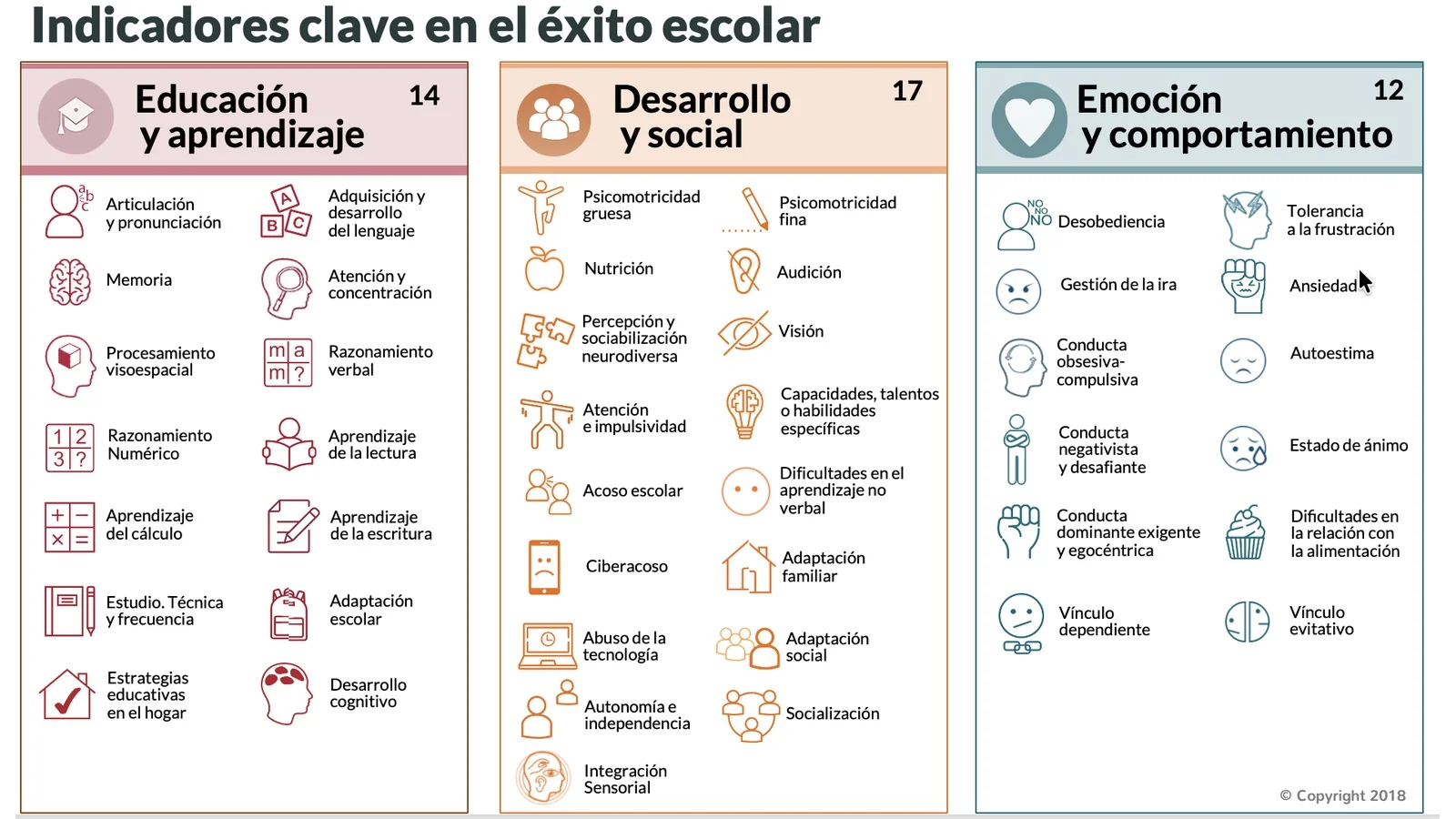
Of the five aspects that most frequently appear as areas to work on with students, only one is directly related to academic learning, memory. The other four are frustration tolerance, attention and concentration, impulse control, and emotional management. In other words, what most influences the day-to-day of a class is usually not found in the math notebook, but in how each child regulates themselves, concentrates, and interacts.
What most influences the day-to-day of a class is usually not found in the math notebook.
This doesn't mean that classrooms are chaos, far from it. It means that the real needs of students go far beyond the purely academic, and that a teacher who knows this complete map has a huge advantage. They can adapt how they teach without having to change what they teach.
Giving everyone the same, just in case
When that information is lacking, there's only one way out. Give everyone the same thing. It would be like giving the same pill to everyone who enters a hospital, just in case. Each patient needs their own, and each student learns in their own way. For those who struggle with memory, the tutor can prepare diagrams, summaries, or stories. For those who manage frustration poorly, they can be anticipated before failure occurs.
Behind a failing grade, there is always a reason
Because when a family takes their child to the hospital because something hurts, they look for the reason. They don't just focus on the pain. The same should happen with a failing grade. The question is not just what grade they got, but what is behind that grade. It could be due to emotional, behavioral, social, or learning factors.
A tool for the tutor, not to replace anyone
This is where DIDE makes sense. It is the first tool designed for the classroom tutor, enabling them to understand each student and make a reality, from the classroom, the attention to diversity that is so often talked about. With each study, the tutor also receives over 5,000 improvement resources, recommendations, and guidelines for the classroom and for the family, adapted to each indicator and age, from 2 to 16 years old, and available in up to 20 languages. Resources to work with all their students, both those who need a deeper look and those who don't, because every child has something to enhance.
And when a profile shows many signs in the observation, that case naturally moves to the guidance team, the true specialists. While they explore in more detail, the tutor continues to work in the classroom with their own resources. Two perspectives moving in parallel, each in their own area, to maximize the success of each student.
Understanding to support, not to classify
The underlying idea is simple. We don't ask anyone for the best results without first giving them the necessary information. A doctor cannot provide good care without knowing their patient, and a teacher can hardly bring out the best in each student without knowing them. Each person has their personalized treatment, just as each student has their unique profile of strengths and needs.
Signs, not labels. Information, not diagnoses. Perhaps we won't change the world. But if with that information we manage to help just one student, we will have changed their world.
Signs, not labels. Information, not diagnoses.
DIDE is the first tool designed for the classroom tutor to get to know their students from day one. Behind it are fifteen years of work by DIDE.ORG Educational Technology, S.L.
(Know and Empower)
(Know and Empower)